
Introduction
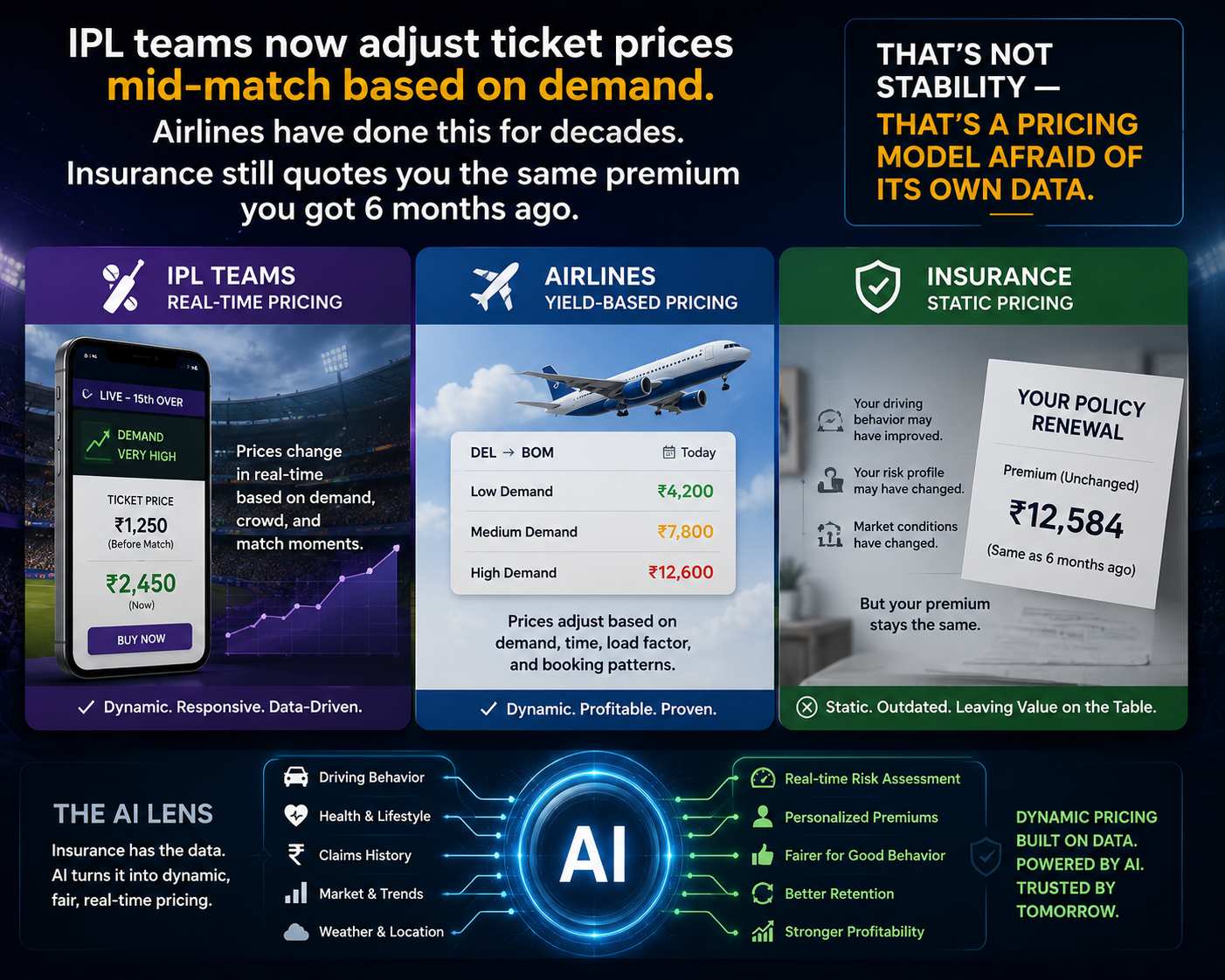
During IPL playoff season, something quietly remarkable happens. Ticket prices for the same seat, the same match, the same stadium shift by the hour. A Kohli fifty sends demand spiking. Prices follow within minutes. The algorithm adjusts before the crowd has finished cheering.
This is not innovation for its own sake. It is a pricing system doing exactly what a pricing system should do: reflect reality as it changes.
Now open your motor insurance renewal email. Same premium band. Same risk category. Same logic your insurer used when they first quoted you, possibly before you moved cities, changed jobs, or drove 40% fewer kilometers because you started working from home.
The gap between those two experiences is not a technology gap. It is a design gap. And it is costing insurers accuracy, and customers fairness.
The IPL Algorithm Is Not Actually Impressive
Here is the uncomfortable truth about IPL dynamic pricing: the underlying logic is not sophisticated. It is supply and demand, computed fast and updated often. What makes it feel impressive is the contrast with every other industry still pretending the world is static.
Airlines have done this for decades. Hotels refined it further. Ride-hailing made it so normal that we now complain about surge pricing the way we complain about traffic: loudly, but without any expectation that it will stop.
Insurance never followed. Not because the math was harder. But because the product was designed in an era when data moved slowly, and the inertia of that design never really got challenged.
The actuary who built your pricing model in 2009 was not wrong. She was working with what existed. The problem is the model she built is still running, slightly patched, in 2026.
What Insurers Actually Know (And Choose Not To Use)
Let us be precise about what modern insurers have access to.
Telematics devices and smartphone apps that track driving behavior in real time. Weather APIs with neighborhood-level granularity. Satellite imagery that can detect roof degradation before a claim happens. Claims velocity data that flags which postal codes are trending toward loss. Social and mobility data that reveals how a city's risk profile shifts after a new highway or a flood event.
The data is not missing. The pipeline from data to pricing decision is what is broken, or more accurately, was never built.
Most insurer pricing cycles operate on an annual or semi-annual basis. An underwriter reviews a risk, sets a rate, and that rate largely holds until the next renewal cycle. In between, the world changes. The insurer's model does not.
This is not a criticism of actuaries or underwriters. It is a systems problem. The workflow was designed for a world with slow data and high computational cost. Both of those constraints have disappeared. The workflow has not.
The Challengers Who Are Already Moving
Usage-based insurance, or UBI, was supposed to be the unlock. Pay-how-you-drive products from Acko, Digit, and a handful of global carriers demonstrated that customers will share behavioral data if the value exchange is fair.
But most UBI implementations stopped at the data collection layer. They built the pipe without redesigning the pricing logic that sits at the other end. You still get a rate at renewal. It is just a slightly more informed rate than before.
The genuinely interesting work happening now is in continuous underwriting. A few carriers, mostly in the US and UK, are beginning to build systems where risk assessment is an ongoing process rather than a point-in-time event. Your premium is not locked at renewal. It responds, within guardrails, to how your risk profile actually evolves.
This is not sci-fi. It is a product decision backed by a different kind of data architecture.
The barriers are real: regulatory approval for rate changes, customer communication design, legacy core systems that were not built for continuous updates. None of these are unsolvable. Several are already being solved.
The Real Reason Static Pricing Persists
Here is the take most industry panels will not give you.
Static pricing persists because it is convenient for the insurer, not because it is good for the customer or even accurate for the risk.
Annual renewal cycles create predictable revenue. They reduce the operational complexity of mid-term adjustments. They protect underwriters from having to defend a pricing decision that changed three months after it was made.
Dynamic pricing would require insurers to explain to a customer why their premium went up in October even though nothing happened to them. That is a harder conversation. Most insurers have decided it is a conversation not worth having.
But that logic is eroding. Customers who are used to Zomato knowing their neighborhood's order patterns, and Swiggy adjusting delivery time predictions block by block, are starting to notice when their insurer treats their entire city as a single undifferentiated blob of risk.
The expectation gap is widening. The question is which carriers decide to close it on their own terms, and which ones wait until a regulator or a better-funded competitor forces the issue.
Conclusion: A Pricing Model That Cannot Listen Is Not a Pricing Model
The IPL lesson is not about sports or entertainment. It is about what happens when you build a system that treats pricing as a continuous conversation with reality rather than a one-time declaration.
Insurance pricing should know when a city has had three consecutive flood warnings. It should reflect when a driver has logged 60% fewer highway kilometers this quarter. It should respond when a commercial property's claims neighborhood shifts from low to high frequency.
The data to do all of this exists today.
The framework for thinking about this is straightforward: price is not a fact. Price is a signal. And a signal that never updates is just noise with a label on it.
Insurers who internalize that will build products that are simultaneously more accurate and more trusted. The ones who do not will find themselves explaining static pricing to a customer base that already understands, from every other part of their digital life, that the world does not stand still.
The question is not whether dynamic pricing comes to insurance. It is whether your company builds it or buys it from someone who did.