
My son asked a question that most AI teams never do
Last weekend, my son was playing doctor.
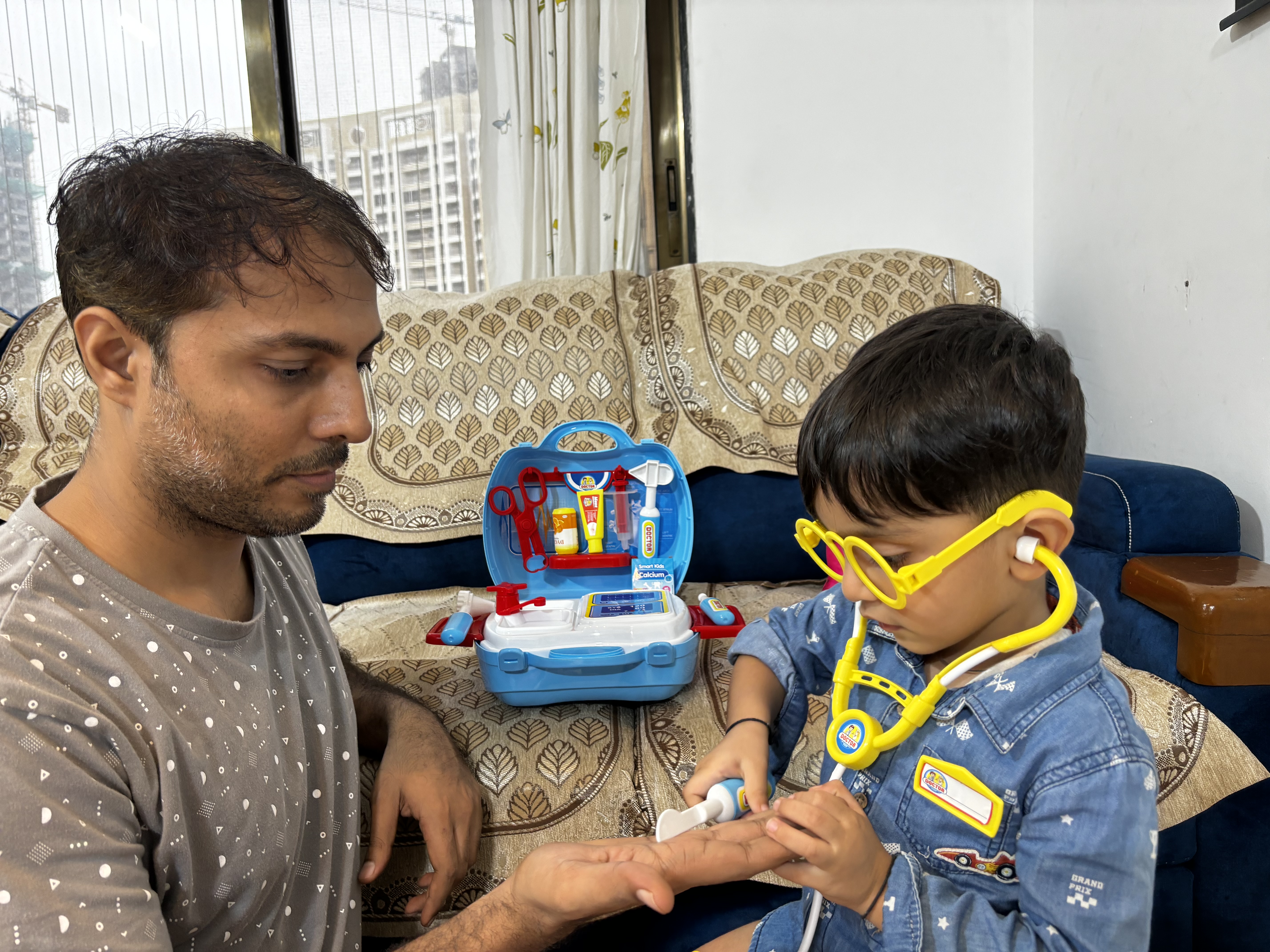
Full setup. Toy stethoscope around his neck. Yellow glasses on. A little blue kit open on the sofa with plastic syringes and a thermometer. He was completely serious about it.
He picked up the toy scanner, ran it over my hand, studied it for a moment, then looked up at me and asked: "Papa, is it right?"
He wanted a confirmation before moving forward. He had the tool. He had done the examination. But he understood, instinctively, that the tool's output needed a human to validate it before the next step.
I said yes. He nodded, satisfied, and continued.
I couldn't stop thinking about that moment for the rest of the week. Because that question -- is it right? -- is the one most organizations quietly skip when they deploy an AI system into a real business process.
The gap between model accuracy and decision accountability
There is a version of AI deployment that most teams are very good at. Train the model. Run validation. Check accuracy metrics. Present results to stakeholders. Get a sign-off on the dashboard. Go live.
That process is real work. It is not trivial. And it produces systems that are often genuinely useful.
But it has a structural gap: it treats the model's output as the decision, rather than as an input to a decision.
When an AI system flags a claim as potentially fraudulent, that flag is not a decision. It is a signal. Someone still has to decide what to do with it. Someone still has to own the outcome.
When a renewal pricing model recommends a 23% increase for a particular account, that recommendation is not a decision. It is a number with a confidence interval attached. A human underwriter, a portfolio manager, or a pricing lead has to look at that number and say: yes, we proceed, or no, we don't.
The accountability question is not "did the model get it right?" It is "who owns it when the model gets it wrong?"
In most deployments I have seen, the honest answer is: nobody, formally. The model passed its tests. The business approved the use case. But the human checkpoint that owns the output, in writing, with context, with authority to override, is missing or vague.
Why this happens, and why it is not the data team's fault
This is not a data science failure. Data teams build what they are asked to build, and they document what they can document.
The accountability gap is an organizational design failure.
When a new AI system goes live, most organizations update the workflow but not the responsibility matrix. The process changes. The RACI does not. The model gets embedded into a decision pipeline, but nobody explicitly redraws who owns the decision now that a machine is involved.
This creates a quiet, dangerous ambiguity. The data team thinks the business owns the output. The business thinks the data team validated it. The compliance team thinks someone else signed off. And the model just keeps scoring, flagging, recommending, untouched.
It works fine until it doesn't. And when it doesn't, the first question asked is: who approved this?
The silence that follows is expensive.
What decision accountability actually looks like
It does not require slowing down AI deployment. It requires adding a layer of human design on top of the technical design.
Here is a simple framework worth building into any AI rollout:
The Decision Owner Test. For every AI output that triggers a business action, name one person whose job it is to review, override, or ratify that output. Not a team. One person. If you cannot name them, you have a gap.
The Override Protocol. Every AI system needs a documented path for a human to say no. Not just technically possible, but operationally expected. If overrides are never happening, that is also a problem. It means humans have stopped looking.
The Wrong Call Review. Schedule a monthly or quarterly review of cases where the AI was wrong and the business acted on it anyway. Not to punish anyone. To understand the failure mode. Most teams only review model performance metrics. Very few review decision quality.
The Accountability Narrative. When something goes wrong, can you tell a clear story of who saw what, when, and what they decided? If the answer requires a forensic audit of logs and model versions, the accountability layer is missing.
None of this is complicated. All of it is skipped more often than it should be.
The stethoscope does not diagnose. The doctor does.
My son knew this at three years old, playing with a toy.
The tool gave him information. He processed it. He asked for a human check before proceeding. Then he made a call.
That sequence -- tool output, human review, explicit decision -- is exactly what most AI systems in production are missing at scale.
Build the model. Absolutely. Invest in accuracy, in features, in infrastructure. That work matters.
But also build the human checkpoint. Define who owns the output. Write it down. Review it. Test it when something breaks.
Your AI system does not decide. Your team does. Or it should.
If your AI system can make a wrong call with zero human accountability attached, you have not built a decision system. You have built a liability with a good accuracy score.
The question my son asked is the right one. Make sure someone on your team is asking it too.