
Every great application starts the same way. Someone looks at a problem in the world and thinks, "There has to be a better way." That spark of recognition, that moment of clarity, is where everything begins. But the distance between a spark and a fully scaled, impactful product is longer than most people expect. And the teams that make it all the way are not the ones with the best ideas. They are the ones who respect the journey.
At NrichSouls, we believe that growth, whether personal or professional, is always a system. Building great software is no different. It follows a path. And when you understand that path deeply, you stop rushing it and start trusting it.
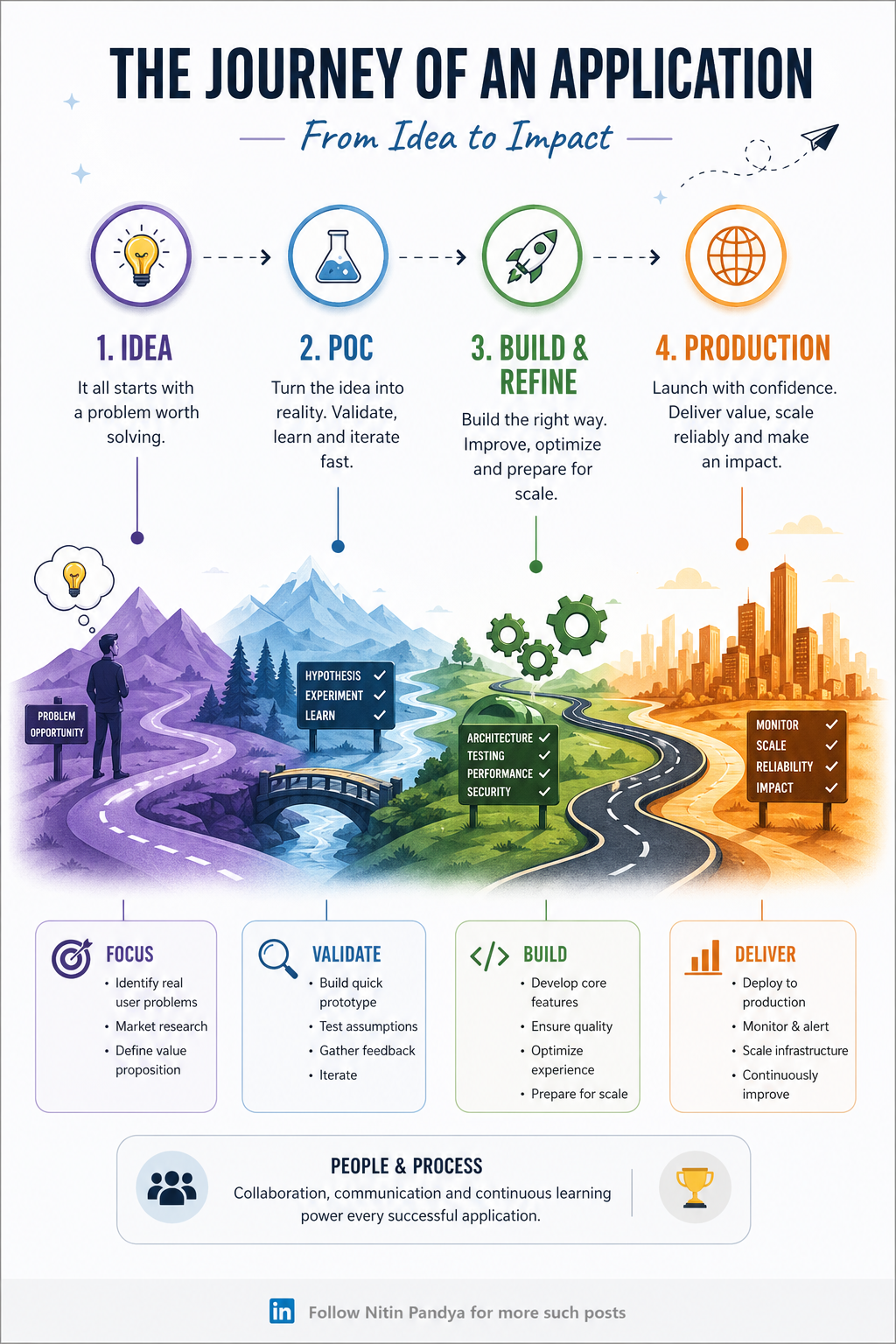
Stage 1: The Idea — Start With a Problem Worth Solving
It all begins with focus.
Not with a feature list. Not with a technology stack. Not with a pitch deck. It begins with a real human problem that deserves a real solution.
The best builders ask three questions at this stage. Who is struggling with something? How significant is that struggle? And what value could a solution deliver to their lives?
This is where market research becomes more than a checkbox. It becomes a conversation with the people you want to serve. You identify real user problems by listening before you build. You define your value proposition not based on what excites you as a creator, but based on what would genuinely change things for your user.
Most teams skip this depth. They fall in love with their solution before they fully understand the problem. And they pay for it later, sometimes much later, when the product launches and nobody cares.
Slow down here. The clarity you build in the idea stage becomes the compass for everything that follows.
Stage 2: The POC — Validate Before You Invest
Once the idea is sharp, the next instinct is to build. Resist it.
The Proof of Concept stage is where the most underrated work happens. You are not building a product yet. You are building a hypothesis and then testing it as fast as you possibly can.
This means creating quick prototypes. It means testing your assumptions with real users before those assumptions have been written into thousands of lines of code. It means gathering feedback and iterating, sometimes painfully, on what you thought you knew.
The three words that should live at the heart of this stage are: Hypothesis, Experiment, Learn.
The goal is not a finished product. The goal is information. The goal is to find out what is true about your users, your market, and your solution before you commit fully to building it.
Teams that do this well move faster in the long run. They do not waste months building the wrong thing beautifully. They get to the right thing sooner because they let reality teach them early.
Validation is not a sign of doubt. It is a sign of maturity.
Stage 3: Build and Refine — Build the Right Way
Now you build. And because you have done the work of stages one and two, you build with confidence.
This is the stage where the craft comes in. Architecture decisions that will support the product as it scales. Testing practices that ensure quality does not get sacrificed for speed. Performance optimization so the experience feels effortless for users. Security considerations so that trust is built into the foundation, not bolted on at the end.
The four pillars of this stage are Architecture, Testing, Performance, and Security. None of them are optional. Each one is a form of respect, for your users, for your team, and for the work itself.
This is also the stage where the shortcuts you did not take in the earlier stages pay off. Because you validated your direction, you are not rebuilding core features from scratch. Because you understood the problem deeply, you are not redesigning the experience. You are refining and improving something that was built on solid ground.
Build the right way. It is slower in the short term and faster in every other way that matters.
Stage 4: Production — Launch With Confidence and Keep Growing
Production is not the finish line. It is the beginning of a new kind of work.
Launching to production means deploying with intention. It means setting up monitoring so you know exactly how your application is behaving in the real world. It means building alerting systems so problems surface quickly. It means having the infrastructure in place to scale when demand grows.
But more than any of those technical elements, production means delivering impact. Real users. Real value. Real feedback coming back into the system so you can keep improving.
The best teams treat every deployment as a learning opportunity. They monitor not just uptime and performance, but user behavior and satisfaction. They scale their infrastructure, yes, but they also scale their understanding of what the product needs to become.
The journey does not end at launch. It evolves. And the teams who thrive are the ones who stay humble, stay curious, and keep listening even after they have shipped.
The Foundation Beneath It All: People and Process
Every stage of this journey depends on something that no technology can replace. Collaboration, communication, and continuous learning.
The most sophisticated architecture will not save a team that does not communicate well. The most thorough testing process will not fix a culture that punishes honesty. The most elegant launch plan will not overcome a team that has stopped learning.
People and process are not soft skills. They are the infrastructure that every great application is built on top of. Invest in them as seriously as you invest in your tech stack.
Closing Thoughts
The journey from idea to impact is not a straight line. It is a winding road through mountains of uncertainty, across bridges of validation, through the green fields of disciplined building, and into the city of real-world impact.
Every stage has its own demands. Every stage has its own rewards.
What matters most is that you respect the system. You do not skip steps. You do not rush stages to feel productive. You trust that doing things right, in the right order, with the right mindset, is what makes the difference between an application that fades and one that changes something.
At NrichSouls, we believe that the best builders are the best learners. And the best applications are built by people who understand that growth, in code and in life, is always a journey worth taking intentionally.