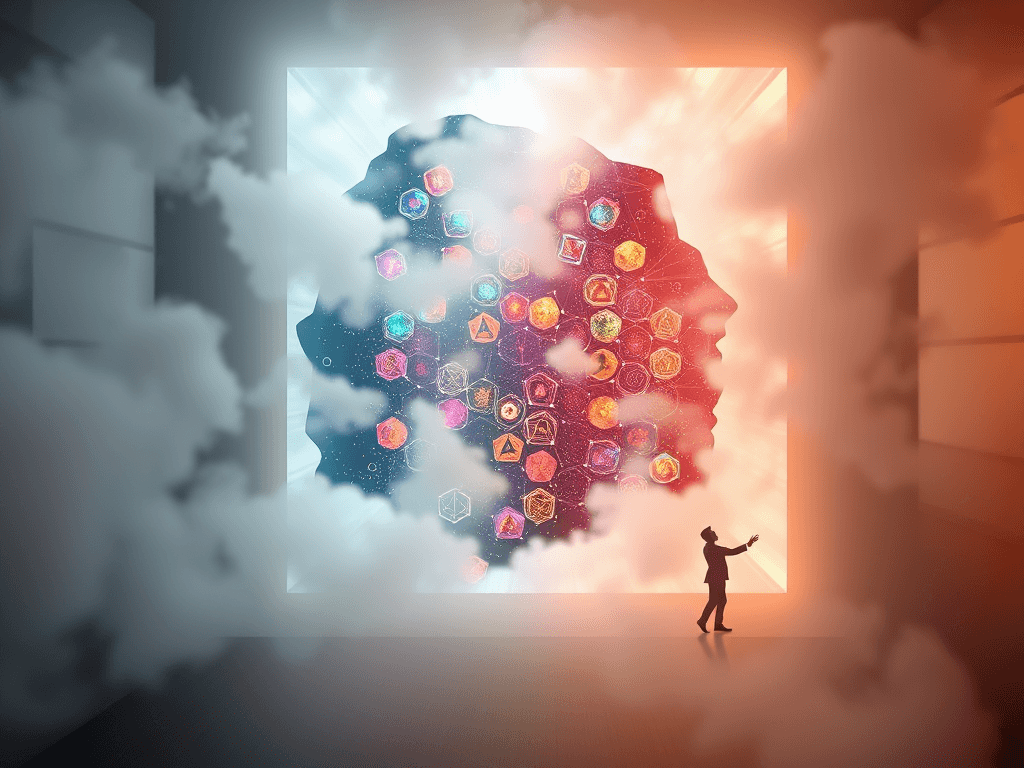
Introduction:
Generative AI isn’t just a buzzword—it’s the invisible engine behind today’s most mind-blowing images, creative breakthroughs, and personalized recommendations. But how do these models actually work? What’s the “secret sauce” behind tools like DALL·E, ChatGPT, deepfake videos, or Netflix’s scarily good recommendations?
Let’s peel back the curtain on the four models driving the AI revolution—Diffusion Models, Transformers, GANs, and Variational Autoencoders (VAEs). Whether you’re an AI enthusiast, a creator, or just AI-curious, you’re about to meet the digital sculptors of our age.
1. Diffusion Models: From Noise to Nuance
🌫️ The Fog-Lifting Magic
Imagine you’re gazing at a fogged-up window. At first, you see nothing but haze. But as the fog clears, shapes emerge—then colors—until, finally, a crystal-clear image appears. That’s the heart of diffusion models: transforming pure randomness (noise) into intricate, lifelike images, audio, or even video.
How Do Diffusion Models Work?
- Start With Noise: The process begins with a random “static”—like an untuned TV.
- Stepwise Denoising: The model, trained on millions of real images, learns to gradually “denoise” this chaos. In each step, it refines the pixels, shaping patterns and details.
- Creation: Step by step, the noise morphs into an image that, moments ago, never existed.
Think of diffusion models as digital sculptors, chiseling away randomness to reveal a masterpiece.
Why Are Diffusion Models Revolutionary?
- Ultra-Realistic Output: They create images and media so lifelike, you’d swear they’re real.
- Powers Viral AI Art: Tools like DALL·E 2, Stable Diffusion, and Adobe’s Firefly use diffusion. They create art, design mockups, and more.
- Accessible Creativity: Used by designers, film studios, and anyone with a laptop to generate world-class visuals in minutes.
Real-World Relatability
If you remember watching a Polaroid develop—blurry at first, then crystal-clear—diffusion models offer the same thrill in the digital world. You witness the birth of something from apparent nothingness.
The Emotional Hook
Ever paused mid-scroll, awestruck by a piece of AI art? That’s diffusion magic. The model “dreams” up visuals that are both new and breathtaking—turning pixels into poetry.
Spread the Word
Next time someone asks about AI art, just say:
“From noise to nuance—diffusion models make digital dreams come true.”
2. Transformers: The Brains Behind Modern AI
🧠 What Makes Transformers So Special?
If diffusion models are sculptors, Transformers are the grand conductors—coordinating words, meaning, and context in text, code, and even images.
How Do Transformers Work?
- Attention Is All You Need: Traditional AI models read sentences one word at a time (like a typewriter). Transformers, however, let each word “pay attention” to every other word, all at once.
- Contextual Understanding: This “attention” mechanism allows Transformers to see the whole picture. They understand meaning, subtlety, and relationships across an entire sentence or paragraph.
- Parallel Processing: They process everything simultaneously, not sequentially. This makes them fast, scalable, and incredibly powerful.
Real-World Applications
- Chatbots & Virtual Assistants: Like ChatGPT, where every response feels human and on-topic.
- Language Translation: Google Translate, where nuanced meaning matters.
- Summarization, Search, and More: From auto-completing your emails to extracting meaning from massive documents.
Why Are Transformers a Big Deal?
- Scalability: Their architecture is the backbone for today’s largest models—GPT-4, BERT, DALL·E, and more.
- Accuracy: They generate more fluent, meaningful, and contextually relevant output.
- Ubiquity: If you’ve used any smart AI tool lately, you’ve met a Transformer.
Memory Hack:
T-R-A-N-S-F-O-R-M-E-R =
The Real AI Now Sees Full Overviews, Remembers Meanings, Excels Rapidly.
Everyday Encounters
- Typed into a chatbot? That’s a Transformer in action.
- Auto-completed a search? Thank the Transformer.
- Seen AI art or text summaries? Yup—Transformers are working behind the scenes.
Spread the Word
Next time you’re wowed by AI’s language smarts, pause for a thought. Remember that Transformers “see the whole picture.” This ability makes digital conversations more human than ever.
Transformers “see the whole picture,” making digital conversations more human than ever.
3. Generative Adversarial Networks (GANs): The Rivalry that Fuels Creativity
🎨 The Digital “Art-Off”
Imagine two AI systems locked in a creative battle:
- The Artist (Generator): Tries to create convincing fakes—art, faces, molecules.
- The Critic (Discriminator): Judges each attempt, deciding if it’s “real” or “fake.”
Over time, the Artist gets better, learning from every critique, until its creations are indistinguishable from reality. This digital rivalry is the genius behind GANs.
How Do GANs Work?
- Generator: Produces new data (images, music, etc.) from scratch, aiming to “fool” the Discriminator.
- Discriminator: Evaluates data, distinguishing real (from the dataset) from fake (from the Generator).
- Adversarial Game: Through thousands (or millions) of cycles, both improve—pushing each other to higher and higher standards.
Why Are GANs So Influential?
- Hyper-Realistic Fakes: Used in deepfakes, synthetic portraits, and AI-powered movie effects.
- Medical Imaging: Enhance resolution, create new examples for training, and aid diagnostics.
- Fashion, Art, Design: Generate endless new patterns, styles, and prototypes.
- Privacy & Anonymization: Create synthetic datasets for safe research and product testing.
More Than Just Fakes
GANs spark innovation wherever imagination meets data. From new drug molecules to unique artwork, GANs help AI “dream up” what’s never been seen before.
Real-World Relatability
Ever used a face-aging app, or seen an AI-generated celebrity image? That’s GANs at work—creative competition in digital form.
Spread the Word
Describe GANs as:
“A creative rivalry—two AIs pushing each other to perfection, unlocking endless new possibilities.”
4. Variational Autoencoders (VAEs): The Art of Learning to Imagine
🧩 Learning Beyond the Obvious
Think of a game where you must guess the whole picture from a handful of scattered puzzle pieces. That’s the spirit behind Variational Autoencoders (VAEs).
How Do VAEs Work?
- Encoder: Translates complex data into a “map of possibilities”—not rigid answers, but a landscape of what could be.
- Sampling: Instead of just remembering data, VAEs sample different points in this map—adding randomness and creativity.
- Decoder: Uses these samples to generate new data—new faces, music, molecules, or more.
The VAE Difference
- Beyond Memory: Classic autoencoders just compress and decompress data. VAEs, however, explore the “in-between”—the creative space, the grey areas.
- Learning the Essence: They don’t just copy data; they understand and imagine. This allows VAEs to generate data that is original but still plausible.
Why Do VAEs Matter?
- Personalized Recommendations: Like Netflix suggesting a show you never would have found, but end up loving.
- Anomaly Detection: Spotting outliers in finance, healthcare, cybersecurity.
- Synthetic Data: For research and privacy, when using real data isn’t safe.
- Drug Discovery: Proposing entirely new molecules that fit certain criteria, accelerating scientific discovery.
Real-World Relatability
Teach an artist not by giving them a full scene. Instead, provide a palette and mood. Then watch them create something brand new. That’s the VAE approach to data.
Spread the Word
Next time someone wonders how machines “learn to be creative,” say:
“VAEs color outside the lines. They teach AI to imagine. AI learns not just to remember.”
Bringing It All Together: Why These Models Matter
- Diffusion Models: Sculpt noise into art, bringing imagination to life step by step.
- Transformers: Master context, powering the smartest text and language tools.
- GANs: Fuel creativity with competition, unlocking infinite new ideas and media.
- VAEs: Teach machines to dream—generating the unseen, the unimagined, the in-between.
These four models are the core engines of the generative AI revolution, each with a unique strength and signature “magic.” Whether you’re a designer or a researcher, understanding these models is essential. It is your ticket to the future of creation if you are an AI enthusiast.
Quick Comparison Table
| Model | Core Mechanism | Key Use Cases | Analogy |
|---|---|---|---|
| Diffusion Models | Gradual denoising | Art, Design, Film, Music | Fog clearing to reveal view |
| Transformers | Attention across context | Language, Chatbots, Summarization | Classroom full of listeners |
| GANs | Generator vs. Discriminator | Deepfakes, Art, Anonymized Data | Rival artists in competition |
| VAEs | Probabilistic encoding/decoding | Recommendations, Anomaly Detection | Guessing whole from pieces |
The SPREAD Framework: Making It Memorable
- Simple:
- Noise becomes art (Diffusion), context becomes meaning (Transformers), rivalry breeds creativity (GANs), and imagination powers recommendations (VAEs).
- Plausible:
- Trusted by giants: OpenAI, Google, DeepMind, Stability AI, Adobe, Netflix, NVIDIA.
- Relatable:
- Analogies that click—foggy windows, classrooms, friendly rivalries, puzzle games.
- Emotional:
- Awe, wonder, curiosity—AI models that make you pause and say “Wow!”
- Actionable:
- Share, explain, tag a friend, try out AI tools, join the creative revolution.
- Duplicable:
- “From noise to nuance.” “Context is king.” “Creative rivalry breeds breakthroughs.” “Imagination beyond memory.”
Your Turn:
- Which AI creation has blown your mind lately?
- Ever noticed a recommendation or artwork that felt eerily right?
- Try explaining one of these models at your next coffee break—or share this blog to spark someone’s curiosity!