
Introduction: You Do Not Need a Supercomputer
One of the most persistent misconceptions about building AI-powered applications is that it requires significant infrastructure and a team of machine learning engineers. For applications built on SLMs, none of that is true. With the right combination of open-source tools, a capable laptop, and a clear use case, you can build a functional, intelligent application in an afternoon.
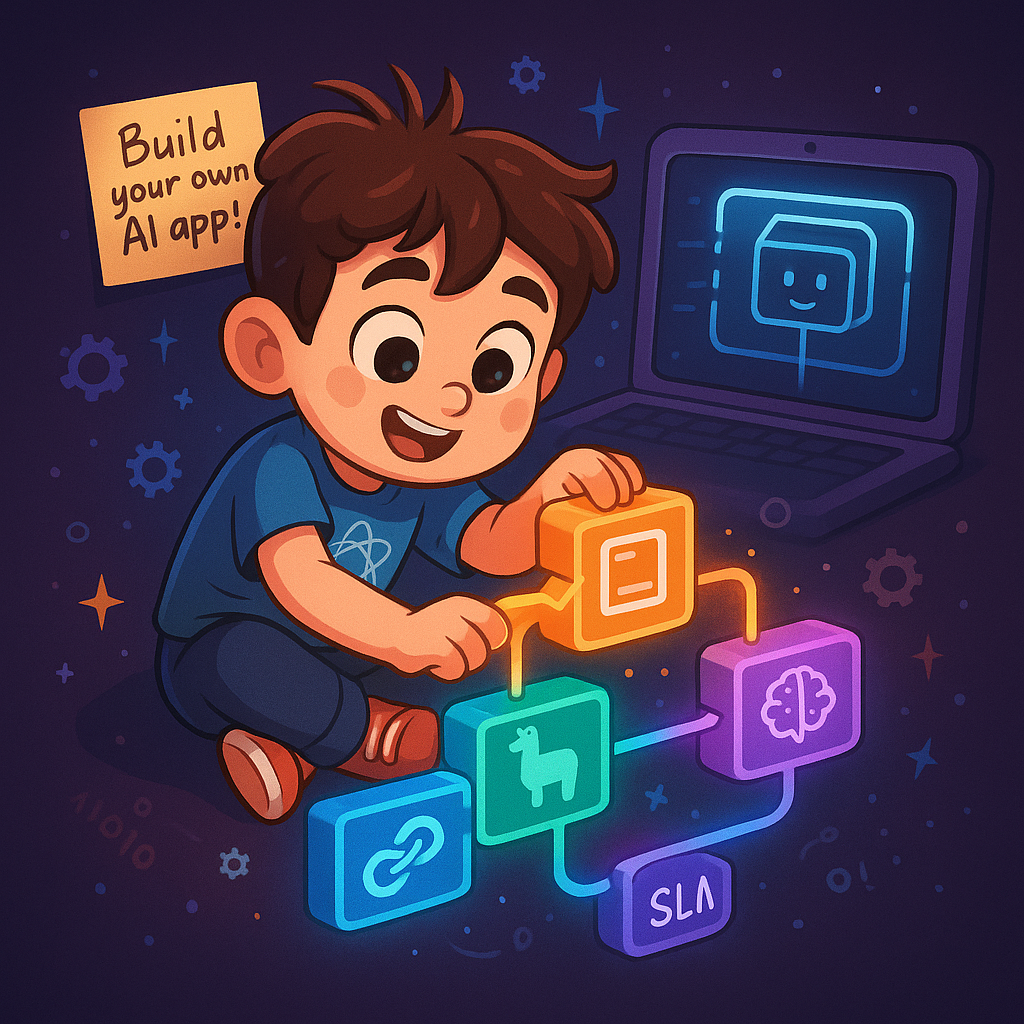
The Four Building Blocks
The SLM itself is the intelligence layer. For most personal and small-team use cases, models like Mistral 7B, Phi-3 Mini, or TinyLlama provide capable starting points.
Ollama is the local deployment layer. It is a tool designed specifically to make running open-source language models locally as simple as possible. You install it, specify the model you want, and it handles the rest. No cloud accounts, no API keys, no data leaving your machine.
LangChain is the orchestration layer. It provides the infrastructure for building more sophisticated applications on top of language models: chains of prompts, memory systems, tool integrations, and retrieval components.
RAG, Retrieval-Augmented Generation, is the knowledge layer. It allows your application to pull in relevant information from your own documents, databases, or data sources and provide that information to the model as context for its responses.
Putting It Together
Ollama runs your chosen SLM locally. LangChain orchestrates the interaction. RAG extends the model's knowledge with your specific data, retrieved dynamically based on the user's query. The result is an application that can have a natural conversation with a user, remember context across the interaction, and draw on your private data to provide accurate, relevant responses.
The Mindset Shift
You are not dependent on a third-party API. You are not bound by the capabilities of a general-purpose model you cannot modify. You are building with tools you control, on data you own, running on infrastructure you manage.
Conclusion
The tools for building SLM-powered applications are freely available, well-documented, and genuinely capable. The most useful thing to do with this information is to pick a use case, download a model, and start building.