
Introduction: The Democratisation of Language Intelligence
One of the most significant developments in the SLM space is the emergence of a rich open-source ecosystem. Unlike the frontier large language models, which are accessible only through commercial APIs or require infrastructure available to a handful of organisations globally, many of the most capable SLMs are freely available, downloadable, and deployable by anyone with a capable laptop or modest server.
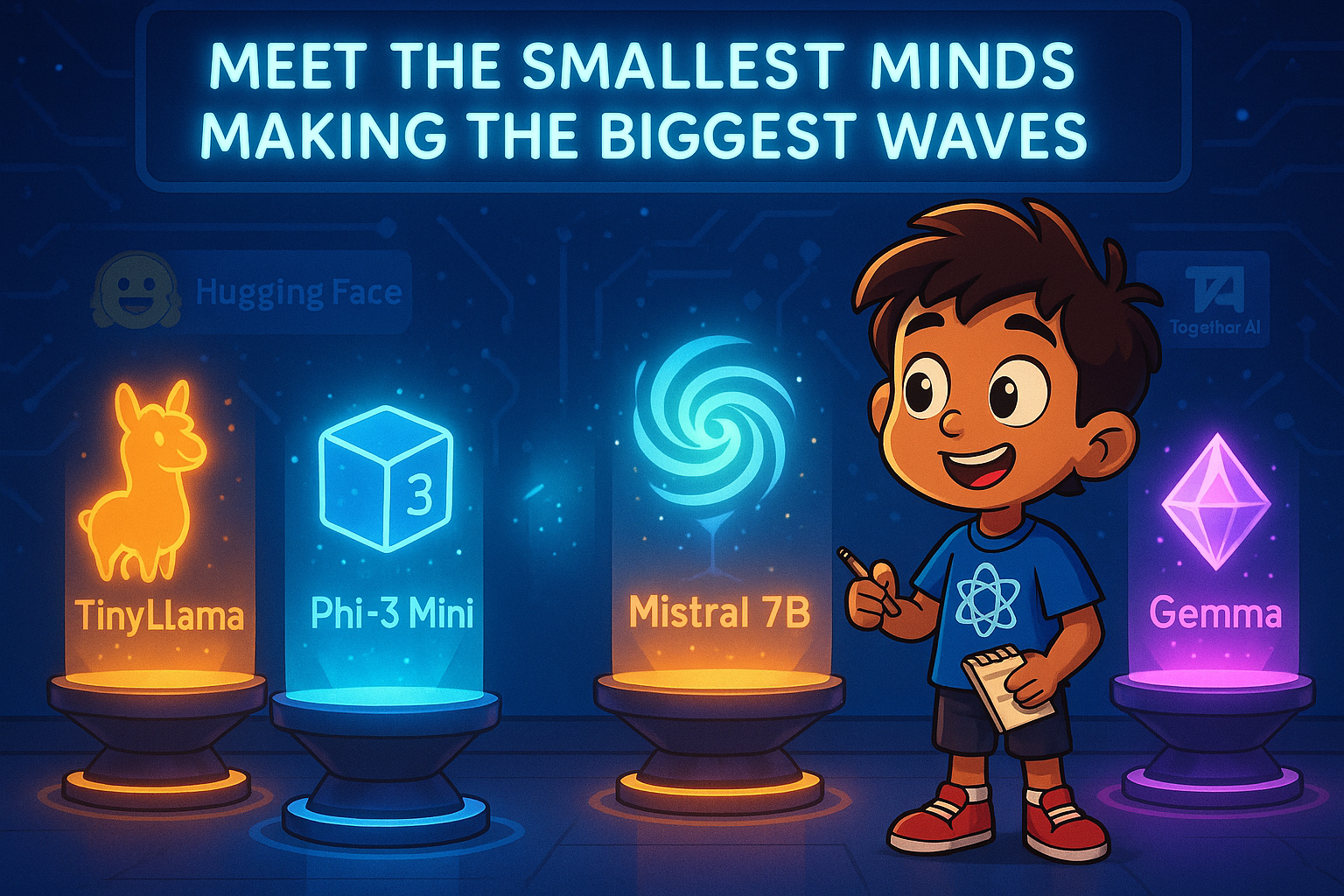
Key Models in the Open-Source SLM Landscape
TinyLlama is a 1.1 billion parameter model trained on two trillion tokens. It is remarkable primarily as a proof of concept: a model this small can achieve meaningful performance on a range of language tasks when trained well.
Phi-3 Mini from Microsoft is a 3.8 billion parameter model that has surprised the research community with its performance on reasoning benchmarks. It demonstrates that thoughtful architecture and high-quality training data can produce a model that punches significantly above its parameter weight.
Mistral 7B has become something of a community favourite in the open-source AI space. At seven billion parameters, its efficiency, strong benchmark performance, and the vibrant community of fine-tuned variants built on top of it make it one of the most practically useful models available.
Gemma from Google is designed with accessibility and responsible deployment in mind. It is lightweight, well-documented, and structured to support on-device and edge deployment environments.
What Open Source Means for Builders
Teams can download, fine-tune, and deploy these models within their own infrastructure without API costs, vendor lock-in, or data governance concerns about third-party processing. The ecosystem surrounding these models, including Ollama for local deployment, Hugging Face for model hosting, and LangChain for orchestration, has made the path from concept to working SLM deployment shorter than at any point in the history of AI.
Conclusion
The open-source SLM landscape has made language intelligence genuinely accessible. The models that were, even two years ago, available only to well-resourced research organisations are now downloadable and deployable by an individual developer with a consumer-grade laptop.