
Introduction: The Expert Who Knows Where Everything Is
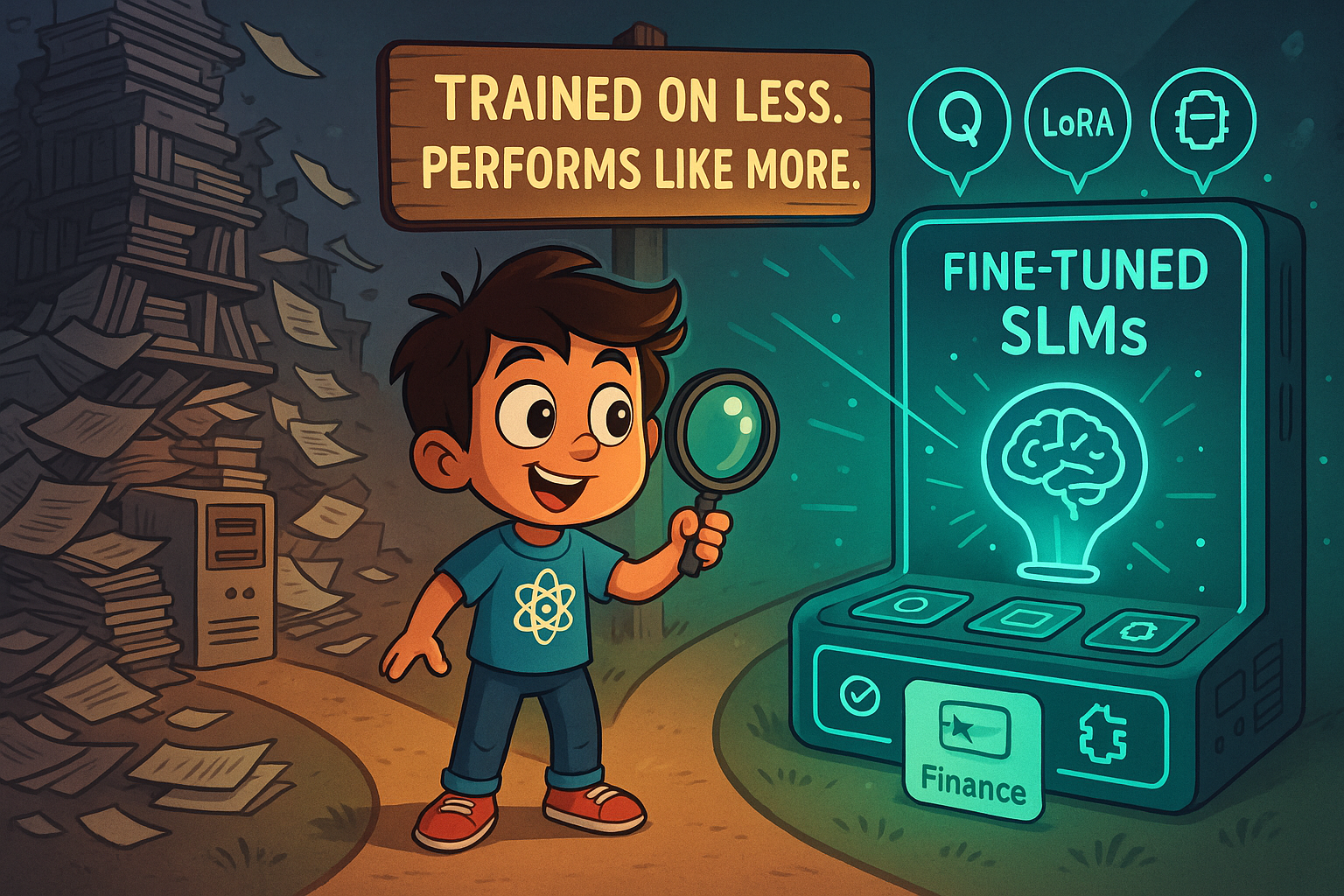
Fine-tuning is the process of taking a pre-trained language model and continuing its training on a smaller, domain-specific dataset. The result is a model that performs significantly better on the tasks it was fine-tuned for than a general-purpose model of similar or even larger size. Focus beats volume when the domain is well-defined.
What Fine-Tuning Actually Does
Where the initial training gives the model broad language capability, fine-tuning sharpens that capability for a specific domain, vocabulary, style, and task type.
The Technical Toolkit
Quantization compresses the model's parameters from high-precision floating-point numbers to lower-precision representations. The result is a smaller, faster model that runs efficiently on edge devices and commodity hardware with minimal loss in task performance.
LoRA, which stands for Low-Rank Adaptation, allows fine-tuning to be performed by updating only a small subset of the model's parameters rather than retraining the entire network. This dramatically reduces the compute and data requirements for fine-tuning, making it accessible to teams without extensive machine learning infrastructure.
Adapter modules are plug-and-play components that can be inserted into a pre-trained model to inject domain expertise without modifying the base weights. Different adapters can be swapped in and out, allowing the same base model to serve different domain-specific use cases efficiently.
Where Fine-Tuned SLMs Are Making Impact
In customer service, fine-tuned SLMs trained on product documentation provide faster, more accurate responses than general-purpose models that lack specific context. In healthcare, clinical SLMs trained on medical literature support diagnostic workflows without the hallucination risks that make general-purpose models dangerous in medical contexts. In finance, compliance-focused SLMs trained on regulatory frameworks flag issues with precision that broader models cannot match.
Conclusion
The fine-tuned SLM is a strategic choice to optimise for the specific problem at hand rather than maintaining general-purpose flexibility that the use case does not require. For organisations deploying AI in production for specific, well-defined tasks, this choice consistently outperforms the alternative.