
Introduction: The Question That Stopped the Room
A colleague once asked a question most of us have quietly wondered: what will happen to our jobs when AI gets even smarter? It is a fair question. It is also the wrong one.
The right question is not about what AI will take. It is about what we choose to become in a world where AI handles more and more of the execution.
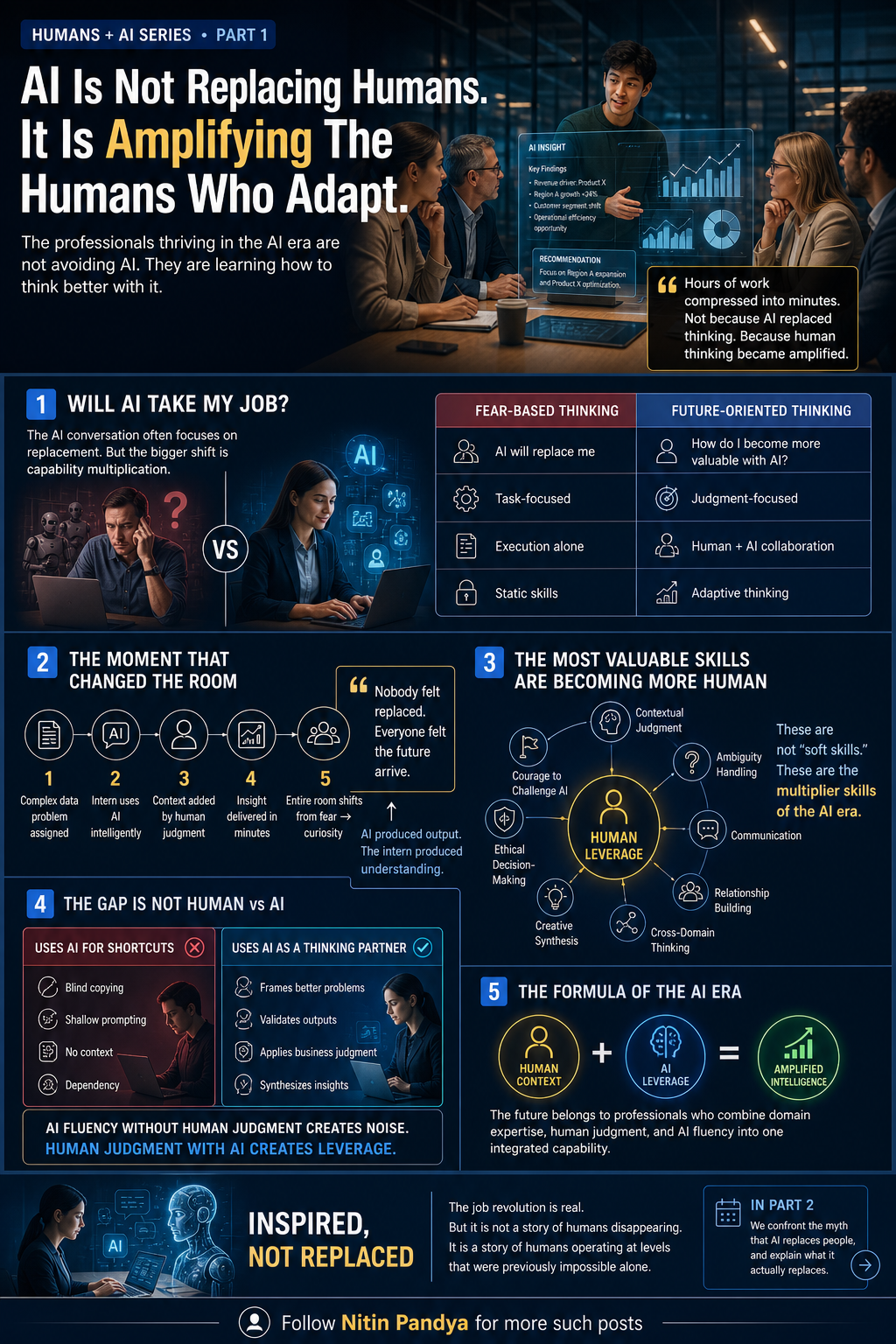
The Intern Who Changed the Room
A few days after that question was asked, an intern was given a complex data problem that would typically take hours of manual work. The intern pulled it up, worked through it with an AI tool, and had a clear, contextualised answer in minutes.
Nobody in the room felt threatened. The reaction was something closer to awe. Because what the intern demonstrated was not that AI had done something impressive. It was that a person who knew how to ask the right question, combine it with real business context, and communicate the result in a way that made everyone smarter had just compressed hours into minutes.
That is intelligence amplified. And that is the shift.
The Fear Is Pointed at the Wrong Target
The professionals being left behind are not those whose tasks AI can replicate. They are those who have not yet learned to work with AI in a way that multiplies their value. The intern demonstrated a capability that sits above the tool: the ability to frame the right problem, bring the right context, and translate the output into something genuinely useful.
That capability is deeply human. AI cannot replace it. It can only amplify it.
Conclusion: Inspired, Not Replaced
The professionals who are thriving in this transition are those who engaged with AI as a genuine thinking partner, brought their expertise and context to the collaboration, and used the resulting leverage to operate at a level they could not have reached alone.
The job revolution is real. But it is not a story of replacement. It is a story of amplification.