
Introduction
There is a moment in almost every tech project when someone says, "Let's just ship the POC." It feels pragmatic. The prototype works. Users are excited. The business wants results. So teams compress timelines, skip stages, and wonder six months later why their "product" feels held together with duct tape.
The journey from idea to product is not a straight line you can shortcut. It is a structured evolution across every layer of your application, from user experience to infrastructure to security. Each stage has a clear purpose. Each layer matures at its own pace. And the teams that understand this framework consistently build systems that scale, without burning out in the process.
This post breaks down that journey, stage by stage, layer by layer, so you can stop treating a POC like a mini-product and start building with real architectural clarity.
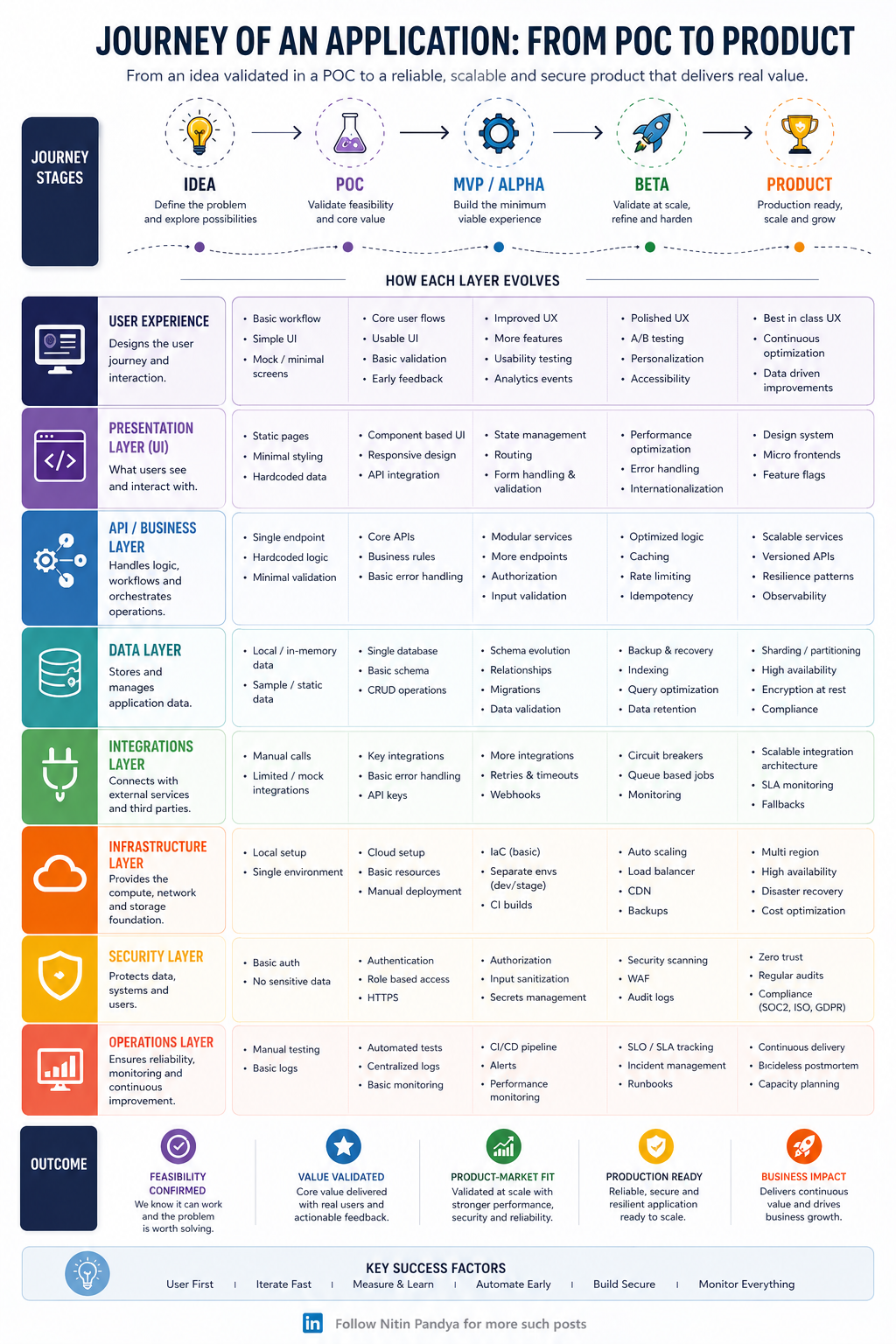
The Five Stages and What They Actually Mean
Most engineering teams know the words: POC, MVP, Beta, Product. Far fewer teams agree on what those words mean in practice.
Here is a clean way to think about it.
Idea is where you define the problem and explore the solution space. No code yet. No architecture. Just clarity on what you are trying to solve and for whom.
POC (Proof of Concept) exists to answer exactly one question: is this technically and commercially feasible? The output is not software. It is a decision. You are validating core value with minimal investment. A good POC confirms feasibility and nothing more.
MVP / Alpha is where you build the minimum viable experience, not the minimum viable feature list. This stage is about product-market fit. You are iterating with real users, gathering real feedback, and building just enough to learn.
Beta is about hardening. You take what works and make it production-grade. This is where performance, security, scalability, and reliability come into focus. Beta is not a soft launch. It is a rigorous stress test.
Product is the ongoing delivery of business impact. You are not done building. You are in continuous improvement mode, driven by data, optimized for growth.
The mistake most teams make is blending these stages. They add production-level security concerns to a POC. They skip Beta hardening because the MVP felt stable. Each of these decisions borrows technical debt from the future.
How Each Layer Evolves Across the Journey
An application is not a monolith. It is a stack of interdependent layers, each with its own maturity curve. Here is how the most critical ones evolve.
User Experience starts as a basic workflow with minimal screens. By the time you reach MVP, you have core user flows, usability testing, and analytics events. Beta brings A/B testing, accessibility, and personalization. In product, UX becomes a continuous, data-driven practice. Best-in-class UX is never finished. It compounds.
The API and Business Layer begins with a single hardcoded endpoint. Through MVP it becomes modular, with proper authorization and input validation. Beta introduces caching, rate limiting, and idempotency. In production, you have versioned APIs, resilience patterns, and full observability. Every stage adds a layer of robustness that the previous stage did not need.
Infrastructure follows a similar arc. You start local. POC moves you to the cloud with basic resources and manual deployment. MVP introduces infrastructure as code and separate environments. Beta adds auto-scaling, load balancing, and backups. Production means multi-region, high availability, and disaster recovery baked in from day one.
Security is where the most dangerous shortcuts happen. Teams skip it in early stages because it slows them down. But by production, you need zero-trust architecture, WAF, SOC2 compliance, and regular audits. The teams that leave security for last spend years retrofitting it. The teams that evolve it with the product make it a structural advantage.
Operations is perhaps the most underappreciated layer. It begins with manual testing and basic logs. MVP introduces automated tests and centralized logging. Beta adds SLO tracking, incident management, and runbooks. In production, you have continuous delivery, blameless postmortems, and capacity planning. Operations is not a team you call when something breaks. It is a discipline you build into every stage.
The Key Success Factors Nobody Talks About Enough
The image that inspired this post ends with five key success factors: User First. Measure and Learn. Iterate Fast. Automate Early. Build Secure. Monitor Everything.
These are not platitudes. They are stage-specific disciplines.
User First means every architectural decision traces back to a user outcome. Not a technical preference. Not an engineering habit.
Measure and Learn means your metrics evolve with your stage. A POC measures feasibility. An MVP measures engagement. A product measures business impact. If your metrics have not changed since launch, you are not learning.
Iterate Fast does not mean cut corners. It means reduce cycle time between hypothesis and feedback. The goal is learning velocity, not shipping velocity.
Automate Early is about compounding returns. Every manual process you automate in MVP pays dividends through Beta, through Product, through every incident and deployment forever.
Build Secure and Monitor Everything are not final-stage concerns. They are foundational disciplines that get layered in progressively. A team that treats security as a checkbox at launch and monitoring as an afterthought is building a liability, not a product.
Conclusion: Build the Right Thing at the Right Stage
The journey from POC to product is one of the most demanding things a team can undertake. Not because the technology is hard, though it often is. But because the discipline to honor each stage, to resist pressure to skip ahead, to evolve every layer with intentionality, requires a level of clarity that most teams never fully develop.
The teams that scale well are not the ones who build fastest. They are the ones who know exactly what each stage demands. They validate before they build. They harden before they launch. They optimize before they grow.
Understand the journey. Respect the stages. Evolve every layer.
Better systems create better decisions.