
Both directors had the same information. Only one saw what was coming.
Picture a quarterly business review. The numbers are good. Churn is down. Retention is climbing. The slide deck is clean, the trend lines are pointing in the right direction, and the presenting director is confident.
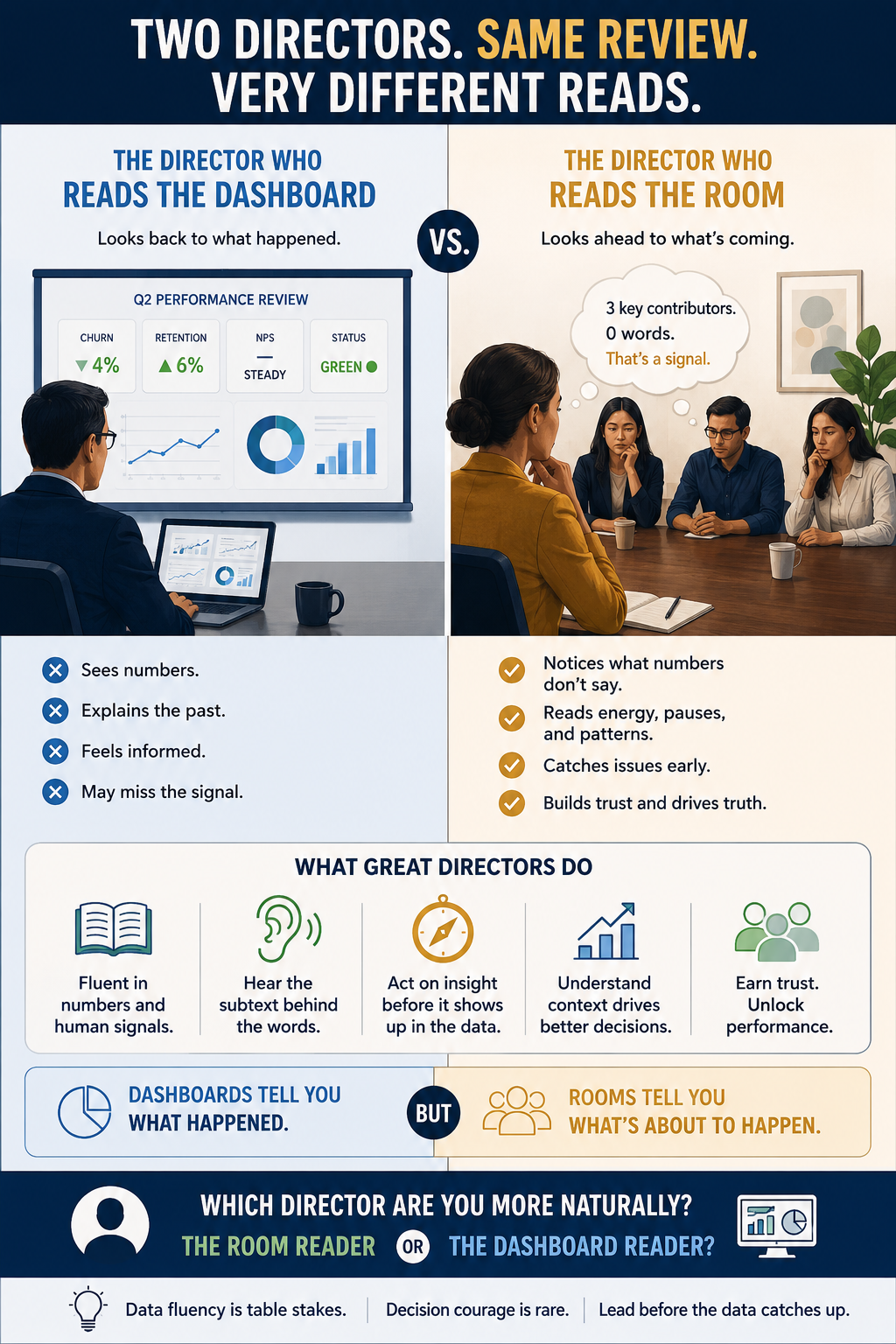
Across the table, another director is not looking at the slides. She is watching the three people who built those numbers sit in complete silence for the better part of an hour.
She flags it after the meeting. "Something is off with that team. The results are fine but the people are not."
Two months later, two of those three people resign. The churn number reverses. The dashboard eventually catches it.
But she saw it first. Without a single data point.
This is the gap that separates good directors from great ones. Not data fluency. Not technical depth. The ability to read two rooms at once: the one made of numbers, and the one made of people.
Why Dashboards Are Brilliant and Insufficient
Let me be clear about something before I make the case for room-reading. Dashboards are not the enemy. They are one of the most powerful inventions in modern management.
A well-built dashboard compresses weeks of signal into minutes of clarity. It removes opinion from conversations that used to run on politics. It gives junior team members the confidence to challenge senior assumptions with evidence. I have spent years building data systems for insurance clients precisely because I believe in what good data does to decision quality.
But dashboards have a structural limitation that nobody talks about enough: they are always late.
By the time a trend appears in your reporting layer, it has already happened in the real world. The churn has already started. The underperformance has already begun. The disengagement is already three months deep.
Dashboards are a rearview mirror. An exceptional one. But a rearview mirror.
The room is a windshield.
What Room-Reading Actually Looks Like
Room-reading is not intuition dressed up as leadership wisdom. It is a skill. A specific, learnable, practicable skill. And like most real skills, it looks deceptively simple from the outside.
Here is what it actually involves.
Noticing silence as data. In any team meeting, the people who are not speaking are often the most important signal in the room. Are they disengaged? Disagreeing but not feeling safe to say so? Burned out? Waiting to be asked? A director who only processes the spoken content of a meeting misses half the information available.
Reading the gap between words and body. "We can make that deadline" said with a straight back and eye contact means something very different from the same words delivered to the table. Both register as yes in the meeting notes. Neither feels the same in the room.
Tracking energy across time. A team that was loud in January and quiet in March has told you something. It may not have a metric attached to it yet. But the pattern is real, and a good director notices before it becomes a number.
Asking the question one level below the obvious one. When results are good, the easy question is "how do we keep this going?" The harder, more useful question is "who is exhausted keeping this going, and for how long can they?"
None of these appear in your BI tool. All of them are leadership-critical.
The Insurance Parallel: Why This Matters in Our Industry
I work in insurance and InsurTech, and I see this tension play out in a very specific way.
Insurance as an industry has become genuinely sophisticated about data. Pricing models, claims risk scores, renewal propensity tools -- the quantitative infrastructure is real and it is improving every year.
But the decisions that go wrong almost never go wrong because the model was inaccurate.
They go wrong because someone trusted the output without reading the room around it.
A claims team that is chronically understaffed will process decisions faster to hit SLA targets. The output looks efficient on the dashboard. The accuracy quietly deteriorates. The room knew. The dashboard found out six months later during a review audit.
A renewal team under pressure to hit retention numbers will approve risks the model flagged as borderline. The quarterly metric holds. The combined ratio suffers twelve months out.
In both cases, the number told one story. The room was telling another. And the director who only had one language could not hear the second one.
A Framework Worth Keeping
Here is how I think about developing both capabilities deliberately, rather than assuming one cancels out the other.
Data fluency means: Can you interrogate a result? Do you know what assumptions sit underneath a metric? Can you distinguish a trend from noise? This is the foundation. Without it, you are guessing with confidence.
Decision courage means: Can you act on what the room is telling you before the data has caught up? Can you name what you are sensing, pressure-test it with the right people, and move before the dashboard confirms what you already know?
The directors worth following are not the ones who trust data more. They are the ones who know when the data has not arrived yet, and who have built enough judgment to act in that gap.
The dashboard will always tell you what happened.
The room will tell you what is about to.
The best leaders are fluent in both. And they know, in any given moment, which one to trust.
Nitin Pandya writes about AI, data systems, and leadership at the intersection of insurance and InsurTech. He leads Data & AI at Mercer and publishes weekly on NrichSouls.