
Introduction
There's a pattern I've noticed across almost every AI initiative that stalls.
Nobody blames the data layer. But it almost always is the data layer.
The data layer is the unglamorous infrastructure that sits underneath every database, every API, every AI model, and every business decision that depends on any of those. It's not a single technology. It's a system of choices: how you store data, how you access it, how you protect it, and how you trust it.
Get it right and nobody notices. Get it wrong and everything else stops working.
This post is a structured framework for building a data layer that scales from a scrappy proof-of-concept all the way to a production-grade, governance-ready system.
The POC Trap: Why "Good Enough" Data Layers Aren't
Most data layer problems are born at the proof-of-concept stage.
The pressure to demo fast is real. So teams spin up a single database, write manual scripts, skip validation, and skip backups. There's no abstraction layer. There's no monitoring. There's definitely no audit trail.
And it works. The demo is great. Stakeholders approve further investment.
Then someone says: "Can we take this to production?"
Now the POC data layer is carrying real users, real transactions, and real business risk. And it was never built for that. The schema hasn't been normalized. There's no retry logic. No data quality rules. No DR plan.
The cost of rebuilding a data layer under a live system is at least five times what it would have cost to design it slightly better from the start.
The insight here is not "over-engineer your POC." It's that your data layer should match your product's current stage of ambition, and you need a clear map of what needs to change at each stage.
A Maturity Model for Your Data Layer
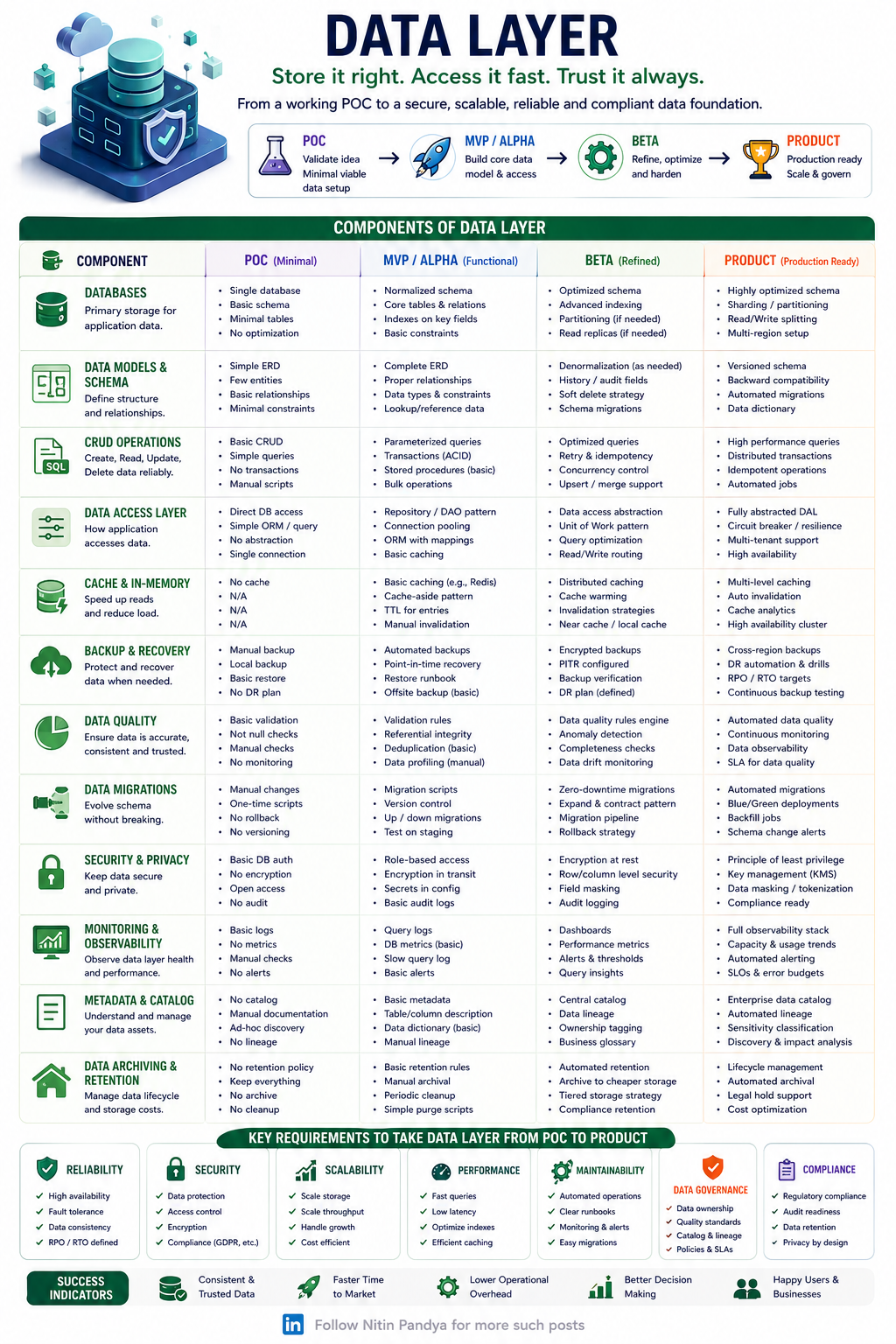
Think of the data layer as having four stages of evolution, each with a different purpose.
POC (Validate the Idea)
At this stage, you are not building for scale. You are building to answer one question: does this work?
Keep it minimal. Single database. Basic schema. Manual backups. No cache, no abstraction, no monitoring beyond basic logs. The goal is to validate the idea, not to serve ten thousand users.
The trap to avoid: building observability, security, and data governance at this stage. That's waste. But do document your schema decisions, even informally. Future-you will be grateful.
MVP / Alpha (Build Core Data Access)
Now you're onboarding real users. The data layer has to start behaving like infrastructure.
Normalize the schema. Introduce transactions. Add parameterized queries, ORM mappings, and connection pooling. Set up basic caching (Redis or equivalent). Add validation rules and referential integrity checks.
This is also the stage where you introduce a basic data dictionary and manual lineage documentation. Not because anyone will audit you. Because your team will double in size in six months and nobody will remember why that lookup table exists.
Beta (Refine and Harden)
The product is live. Users depend on it. Stakes are higher.
Introduce data quality rules engine, anomaly detection, and completeness checks. Implement zero-downtime migrations, encryption at rest, row-level security, and audit logging. Build dashboards for observability. Define your RPO and RTO.
If you skipped data quality at MVP, this is when it bites you. Anomalous data in production causes more AI model failures than bad model design ever does.
Product (Govern and Scale)
This is where the data layer earns its keep. Versioned schema. Automated data quality with SLAs. Enterprise data catalog with lineage. Blue/green deployments. Compliance-ready with GDPR and similar regulatory requirements built in.
At this stage, the data layer is not just infrastructure. It is a product in itself. Teams depend on it. Auditors review it. Business decisions are made from it.
The measure of a mature data layer: can a new engineer trust the data on Day 1 without asking anyone?
The Components Nobody Talks About (Until It's Too Late)
Of the twelve core components in a production data layer, three are consistently underinvested and consistently cause the most failures.
Data Observability. Most teams add basic logs at POC and never upgrade. A production system needs a full observability stack: query logs, performance metrics, alerts and thresholds, SLOs and error budgets. Without it, you are flying blind. You find out about data problems when a business user complains, not when the alert fires.
Data Quality. Basic not-null checks are not data quality. Production data quality means automated validation rules, deduplication, drift monitoring, and SLAs on data freshness. In insurance, a claims model trained on unvalidated data isn't just inaccurate. It's a liability.
Metadata and Catalog. Manual documentation decays faster than code comments. A production system needs a central catalog, automated lineage, ownership tagging, and a business glossary. This is what separates a data team that can answer audit questions from one that can't.
The Framework: Three Questions for Every Stage
Before you move from one stage to the next, ask your team these three questions.
Can we trust the data? If you cannot answer yes with confidence, you are not ready to move forward. Trust is a function of quality rules, validation, and monitoring. Not of how good your model is.
Can we recover? Define your RPO (how much data you can afford to lose) and your RTO (how fast you need to recover). If these are undefined, you do not have a production data layer. You have a hope strategy.
Can someone else run this? Documentation, runbooks, and automated operations are not optional at product stage. If only one person understands the system, that's a risk, not an asset.
Conclusion
The data layer is not a technology decision. It is a product decision.
It must evolve as your product evolves. The POC data layer that got you funded is the same one that will hold you back at scale if you never revisit it.
The best teams I have worked with don't treat the data layer as plumbing. They treat it as the foundation of every decision their system will ever make.
Store it right. Access it fast. Trust it always.
Build in that order, at every stage, and your AI systems will have something most AI projects never do: a foundation worth building on.