
Introduction: The Myth of the All-Knowing Agent
There is a persistent myth that the path to a powerful agent is finding a powerful model. This myth is responsible for a great deal of wasted time, budget, and frustrated engineers.
Real-world agentic AI systems are not powerful because of their models alone. They are powerful because someone invested in engineering the context in which those models operate.
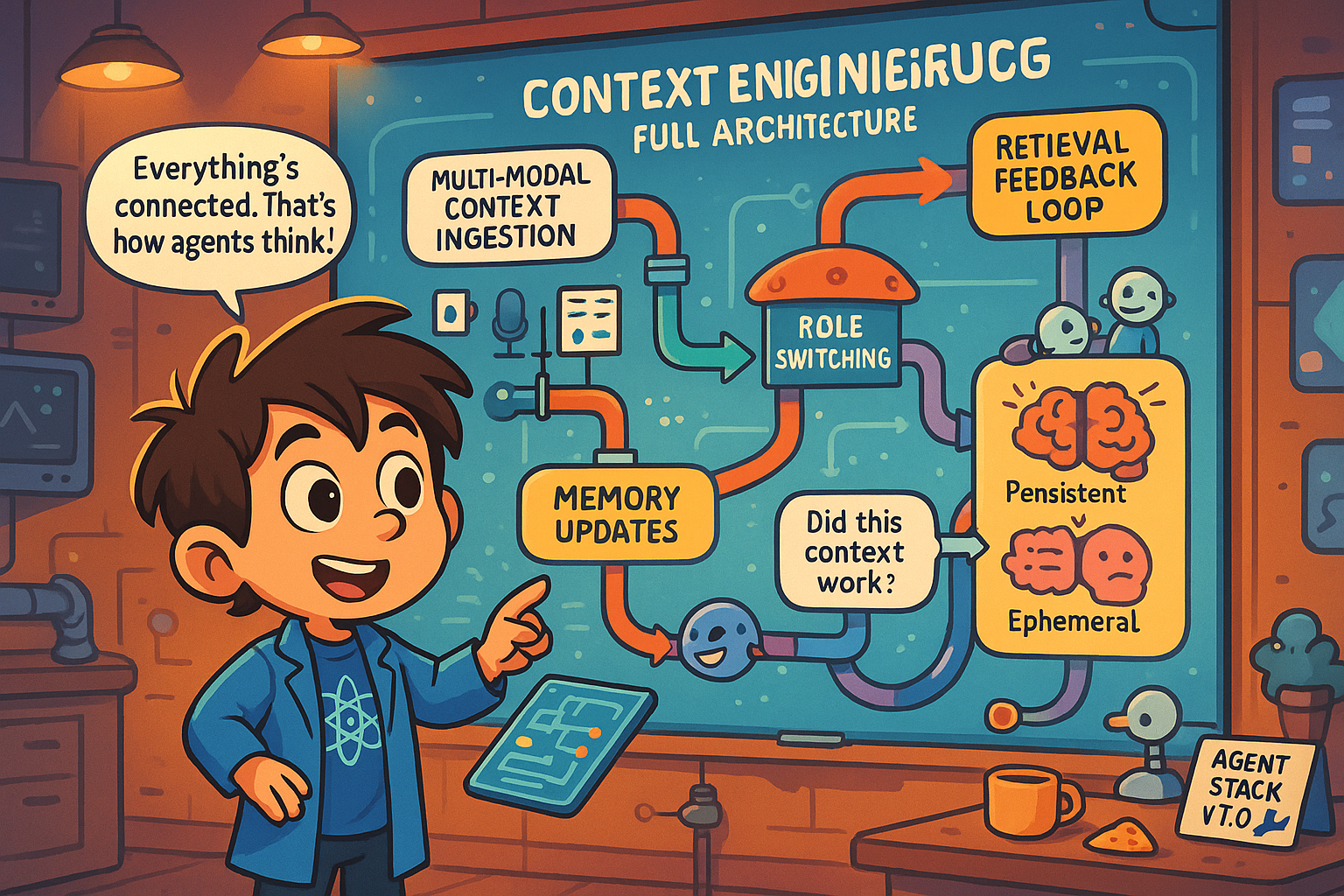
The Full-Stack Context Engineering Architecture
Multi-Modal Context Ingestion is the capability to receive and process information from diverse sources. Text documents, voice input, screenshots, structured spreadsheets, API responses, and real-time data streams can all be relevant to an agent's task.
Role Switching on Demand allows the agent to shift its persona, tone, and priority orientation dynamically based on the context of the current interaction. A single agent might need to act as a researcher when exploring a problem, a writer when communicating findings, and a reviewer when evaluating outputs.
Adaptive Memory Updates ensure that the agent's persistent memory is not static. As the agent accumulates experience, the memory system should update to reflect what has proven relevant and let go of what has become outdated.
Retrieval Feedback Loops close the gap between what the agent retrieves and what actually produces good outcomes. By tracking whether retrieved context led to successful task completion, the system becomes increasingly precise about what information matters.
What This Means for Teams Building Today
Start with context architecture before you start with model selection. Define what your agent needs to know, what it needs to remember, what roles it needs to play, and what tools it needs to access. Build those systems first. The model will perform better in a well-engineered context environment regardless of which one you choose.
Conclusion
The AI agent is the user-facing interface. Context engineering is the product behind the interface. The investment in designing thoughtful, layered, adaptive context systems is what determines whether an AI agent is a compelling demonstration or a genuine operational capability.