
Introduction: Intelligence Is Knowing Which Tool to Reach For
Modern agents have access to remarkable capabilities: web browsing, code execution, database queries, API calls, document generation, mathematical computation. But having access to these tools does not make an agent intelligent. Knowing which tool to use, when, and why is what produces genuinely capable performance.
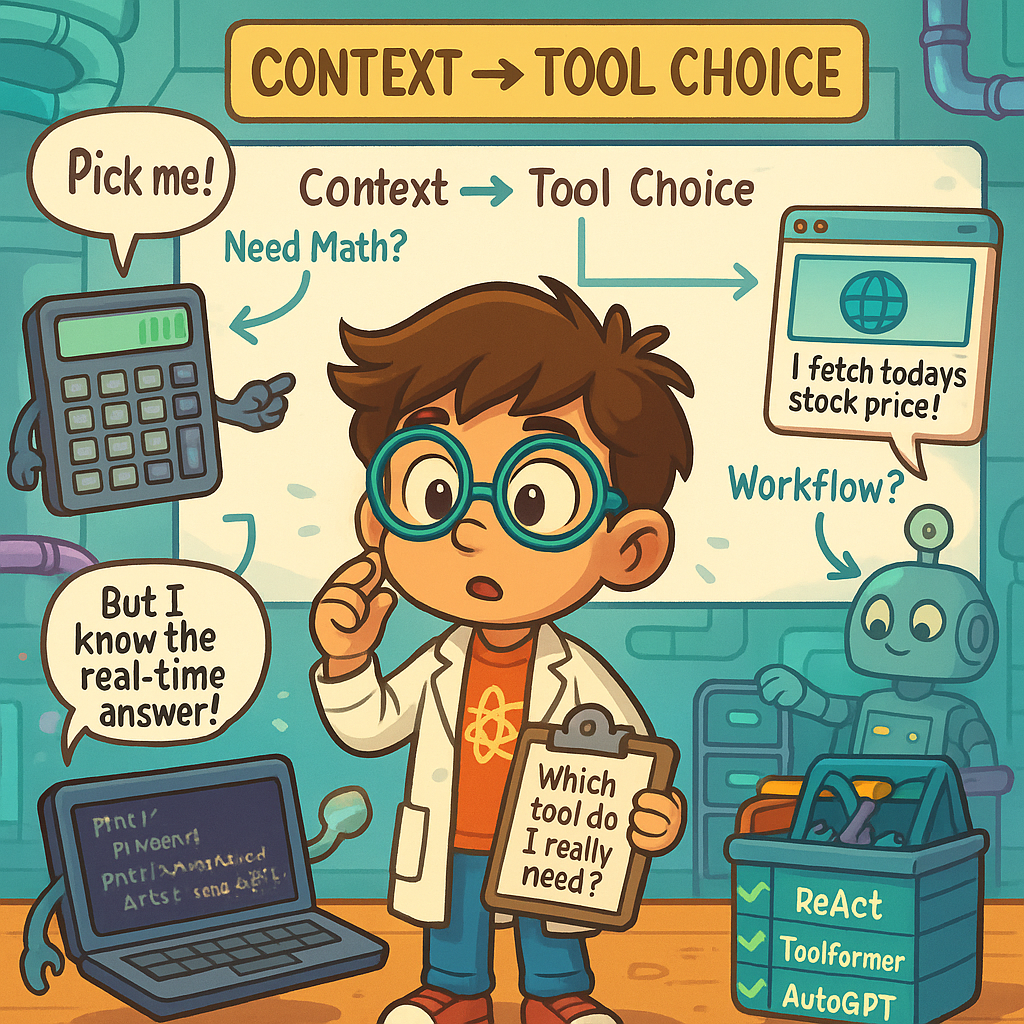
Why Tool Selection Is a Context Problem
The right tool for any given task depends on factors that change with every interaction: the nature of the request, the state of the conversation, the user's goal, and the current information environment.
An agent asked to summarise a document should retrieve and process that document, not search the web. An agent asked about current market conditions should use live data retrieval, not rely on training data that may be months out of date. This is why tool-aware context design explicitly includes information about what tools are available and what signals should trigger their use.
Three Frameworks for Intelligent Tool Use
ReAct, which stands for Reason and Act, is a framework where the agent explicitly reasons about what it knows versus what it needs to find out before deciding what action to take.
Toolformer is a model training approach where the model learns autonomously to insert tool calls at the points in its reasoning where they genuinely add value.
Goal-directed planning loops have the agent plan a sequence of tool-assisted actions, execute them, observe the results, and re-plan based on what it learns. This iterative approach is particularly powerful for complex, multi-step tasks.
The Overuse and Underuse Problem
Practitioners building production agents consistently encounter two failure modes. Tool overuse happens when an agent reaches for external tools for tasks it could handle through reasoning alone. Tool underuse happens when an agent relies on its training data for tasks that require current information.
Conclusion
Context-aware tool use is what separates agents that are impressive in demonstrations from agents that are reliable in production. The intelligence is not in the tools themselves. It is in the context that tells the agent when and why to use them.