
Introduction
There's a layer in your application that most users never see, most junior developers underestimate, and most tech leaders only truly appreciate after something breaks in production. That layer is the API and Business Layer. It's the engine beneath the surface. It connects your frontend to your data, enforces your business rules, protects your resources, and determines whether your application survives real-world usage or collapses under pressure. If you're building a product today and you're not thinking carefully about this layer, you're building on sand.
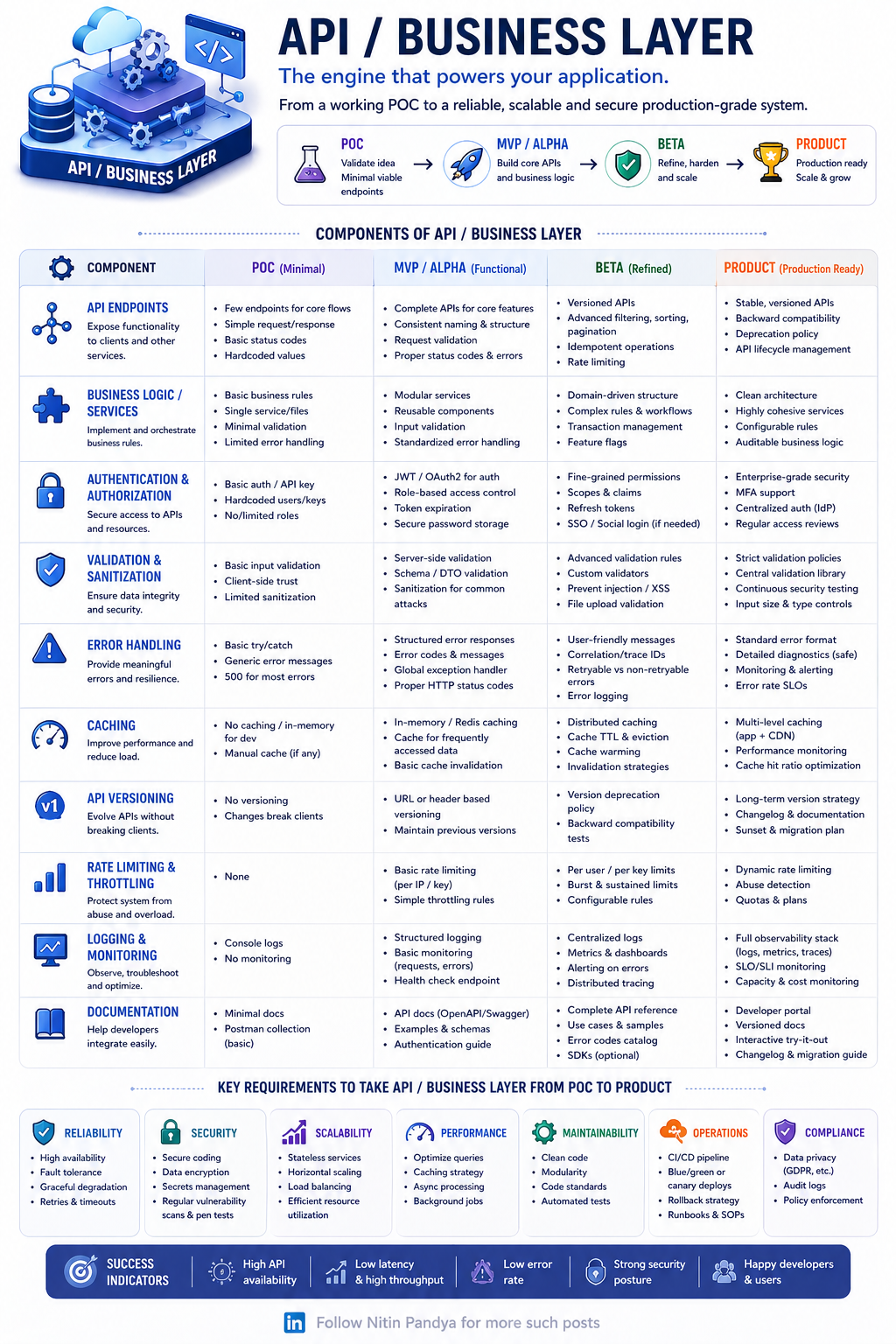
This post breaks down why this layer matters so deeply, what it looks like at each stage of your product's journey, and the key requirements you need to take it from a proof of concept to a production-grade system.
Why the API and Business Layer Is the Heart of Your Application
When developers start building, the API layer is often treated as an afterthought. You wire up a few endpoints, return some JSON, and call it a day. That works at the prototype stage. But the moment real users arrive, real data starts flowing, and real stakes are on the table, every shortcut you took in this layer becomes a liability.
The API and Business Layer is responsible for exposing your application's functionality to the outside world, orchestrating your business logic, securing access to your resources, and ensuring the integrity of your data. It is the single most critical interface between your system and everyone who interacts with it, whether that's a frontend application, a third-party integration, or a mobile client.
A weak API layer creates cascading problems: security vulnerabilities, inconsistent data, poor performance, developer frustration, and ultimately, a product that users stop trusting.
What the API Layer Looks Like at Each Stage
One of the most useful ways to think about this layer is through the lens of your product's maturity. What you need at POC stage is very different from what you need in production.
At the POC stage, simplicity is the goal. You need just enough to validate your idea. A few endpoints for core flows, basic status codes, hardcoded values, and simple authentication. There's no need for rate limiting or distributed caching here. You're testing assumptions, not building for scale.
At the MVP and Alpha stage, things get more structured. You're building reusable, modular services. You introduce JWT and OAuth2 for authentication, server-side validation, structured error handling, and in-memory caching. Your APIs have consistent naming conventions, proper HTTP status codes, and basic documentation. This is where good habits either get formed or skipped.
At the Beta stage, you're refining and hardening. Domain-driven design starts to matter. You need fine-grained permissions, transaction management, advanced validation to prevent injection and XSS attacks, distributed caching with TTL and eviction policies, centralized logging, metrics, and alerting. Rate limiting is now per user and per key, not just a switch you turn on.
At the Production stage, you are operating at a different level entirely. Versioned APIs with backward compatibility and deprecation policies. Enterprise-grade security with MFA and centralized identity providers. Multi-level caching with CDN integration. A full observability stack covering logs, metrics, and distributed traces. SLO-based monitoring. A developer portal with interactive API documentation. This is not complexity for its own sake. Every element exists because real-world systems demand it.
The Key Requirements That Bridge POC to Product
The infographic that inspired this post highlights seven cross-cutting requirements that determine whether your API and Business Layer can make the journey from prototype to production. These deserve to be understood, not just listed.
Reliability means your system stays up when things go wrong. This requires fault tolerance, graceful degradation, retries with backoff, and timeout management. A reliable system is designed to fail gracefully, not catastrophically.
Security is not a feature you add at the end. It's a practice woven into how you write code, how you store secrets, how you manage encryption, and how often you run vulnerability scans and penetration tests.
Scalability means your architecture can grow without a full rewrite. Stateless services, horizontal scaling, load balancing, and efficient resource utilization are the foundations here.
Performance is about the user experience on the other end of every API call. Optimized queries, async processing, smart caching strategies, and background jobs all contribute to a system that feels fast and reliable.
Maintainability is what separates systems that teams love from systems that teams dread. Clean code, modularity, code standards, and automated tests make the difference between a codebase you can evolve and one you're afraid to touch.
Operations covers how you deploy, monitor, and recover. CI/CD pipelines, blue/green deployments, rollback strategies, and documented runbooks mean that your team can ship confidently and recover quickly when things go wrong.
Compliance is increasingly non-negotiable. Data privacy regulations like GDPR, audit logs, and policy enforcement are not optional for any product serving real users in today's world.
Conclusion: Build the Engine Right
The API and Business Layer is not glamorous. It doesn't show up in screenshots or marketing decks. But it's the reason your application either works reliably at scale or quietly falls apart under pressure.
The good news is that you don't have to build it all at once. Start with what your current stage demands. Be intentional about the shortcuts you take early, and have a clear plan for closing those gaps as your product matures.
The developers and teams who get this right don't just build faster. They build systems that earn the trust of their users, their stakeholders, and their own engineering teams.
Build the engine right, and everything built on top of it gets better.
NrichSouls is dedicated to helping builders, learners, and leaders grow with clarity and purpose. Follow along for more insights on tech, growth, and meaningful work.