🌎 Demystifying Autonomous Agents Like Auto-GPT, Devin, and Cognosys
Uncover the real difference between AI agents and chatbots in 2025. Explore use cases, tools like Auto-GPT and Devin, and what this shift means for your business.
🚀 Introduction: More Than Just a Talking Bot
In 2025, conversations with machines are no longer limited to scripted customer support. With the rise of autonomous AI agents, the lines between chatbots and true digital collaborators have blurred. But what exactly sets these apart? And why does it matter for businesses, developers, and consumers alike?
🤖 Chatbots in 2025: Still Useful, Still Limited
What is a Chatbot?
A chatbot is a software application designed to simulate conversation with users, often pre-programmed to respond to specific queries. Think of customer service bots that handle return requests or FAQ bots embedded on websites.
Key Characteristics:
- Rule-based or NLP-driven
- Reactive, not proactive
- Often dependent on decision trees
- Deployed in narrow contexts
Use Cases:
- Customer support
- Lead qualification
- Booking assistance
Limitations:
Chatbots struggle with tasks that require memory, reasoning, or autonomy. They're great at helping you cancel an order, but not so much at suggesting a better product based on your history.
🤖 AI Agents in 2025: Your Digital Colleague
What is an AI Agent?
An AI agent is an autonomous system designed to perceive, reason, plan, and act toward achieving a goal. Unlike chatbots, agents can execute tasks independently, connect to APIs, write code, and even make complex decisions.
Examples:
Key Characteristics:
- Goal-oriented
- Autonomous decision-making
- Multi-step task execution
- Contextual memory and learning
- Integrates with tools and APIs
Real-World Use Cases:
- Automating end-to-end report generation
- Market research and trend analysis
- Coding assistants that write and test code
- Product development planning
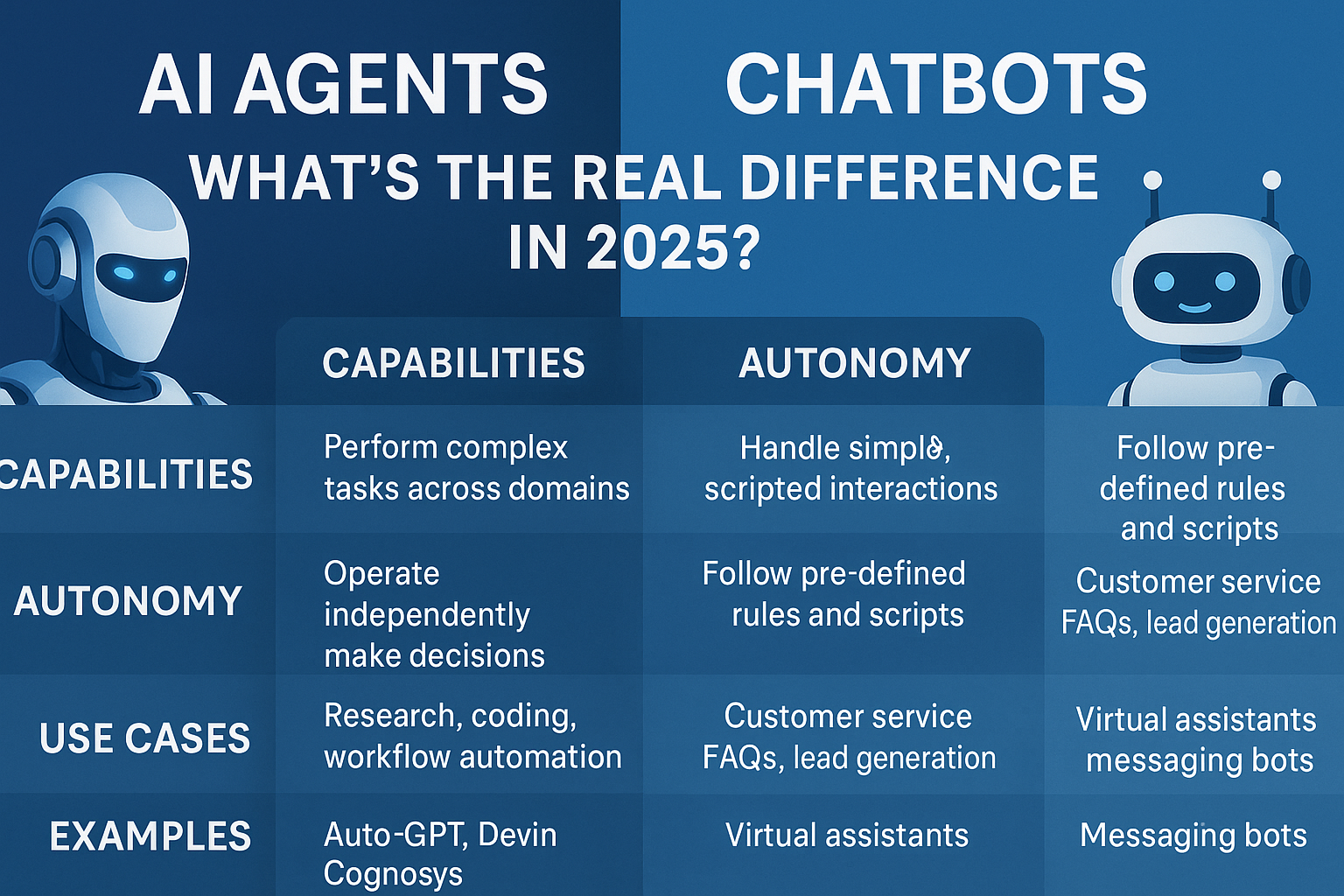
🧠 AI Agents vs. Chatbots: Quick Comparison Table
| Feature | Chatbots | AI Agents |
|---|---|---|
| Goal-Oriented | ❌ No | ✅ Yes |
| Autonomy | ❌ Low | ✅ High |
| Context Retention | ❌ Limited | ✅ Strong |
| Task Execution | ❌ Single-step | ✅ Multi-step |
| Tool Integration | ❌ Basic | ✅ Advanced (APIs, apps) |
| Learning Ability | ❌ Minimal | ✅ Continual |
🚀 Why This Evolution Matters
AI agents represent a shift from assistants to collaborators. In industries like healthcare, finance, and marketing, they can:
- Free up human hours
- Increase decision-making speed
- Reduce errors by handling repetitive workflows
- Personalize customer experiences at scale
🔍 FAQs
What is the difference between AI agents and chatbots?
AI agents are autonomous, goal-oriented systems capable of executing complex, multi-step tasks. Chatbots are typically reactive, providing scripted or NLP-based responses to direct inputs.
Are AI agents replacing chatbots?
Not entirely. They serve different purposes. While chatbots handle basic interactions, AI agents are better suited for complex automation and decision-making.
What are the best AI agent tools in 2025?
Top tools include Auto-GPT, Devin by Cognition Labs, Cognosys, and AgentGPT. Many integrate with productivity platforms or codebases.
📈 Final Thoughts: Not Just Smarter Bots—Smarter Work
AI agents aren’t just glorified chatbots. They represent a profound leap in how humans collaborate with machines. As these systems become more intelligent, context-aware, and autonomous, we’re looking at a future where AI does more than talk—it thinks, plans, and builds with us.
References: OpenAI.com, GoogleAI.blog, DeepMind.com, MIT Technology Review, Stanford HAI, Microsoft AI, Nvidia Research, HBR.org, McKinsey.com, Gartner.com, IBM Research, Forbes.com, TechCrunch, VentureBeat, Wired.com