
Introduction: AI That Acts, Not Just Answers
For most of its early history, AI was a brilliant observer. It could analyse patterns, forecast outcomes, and surface insights. But it sat quietly, waiting for a human to do something with that information. That era is ending.
Agentic AI marks a fundamental shift from AI that predicts to AI that decides and acts. If you have ever wished your tools could just handle things without you needing to prompt, configure, or supervise every step, Agentic AI is the answer to that wish.
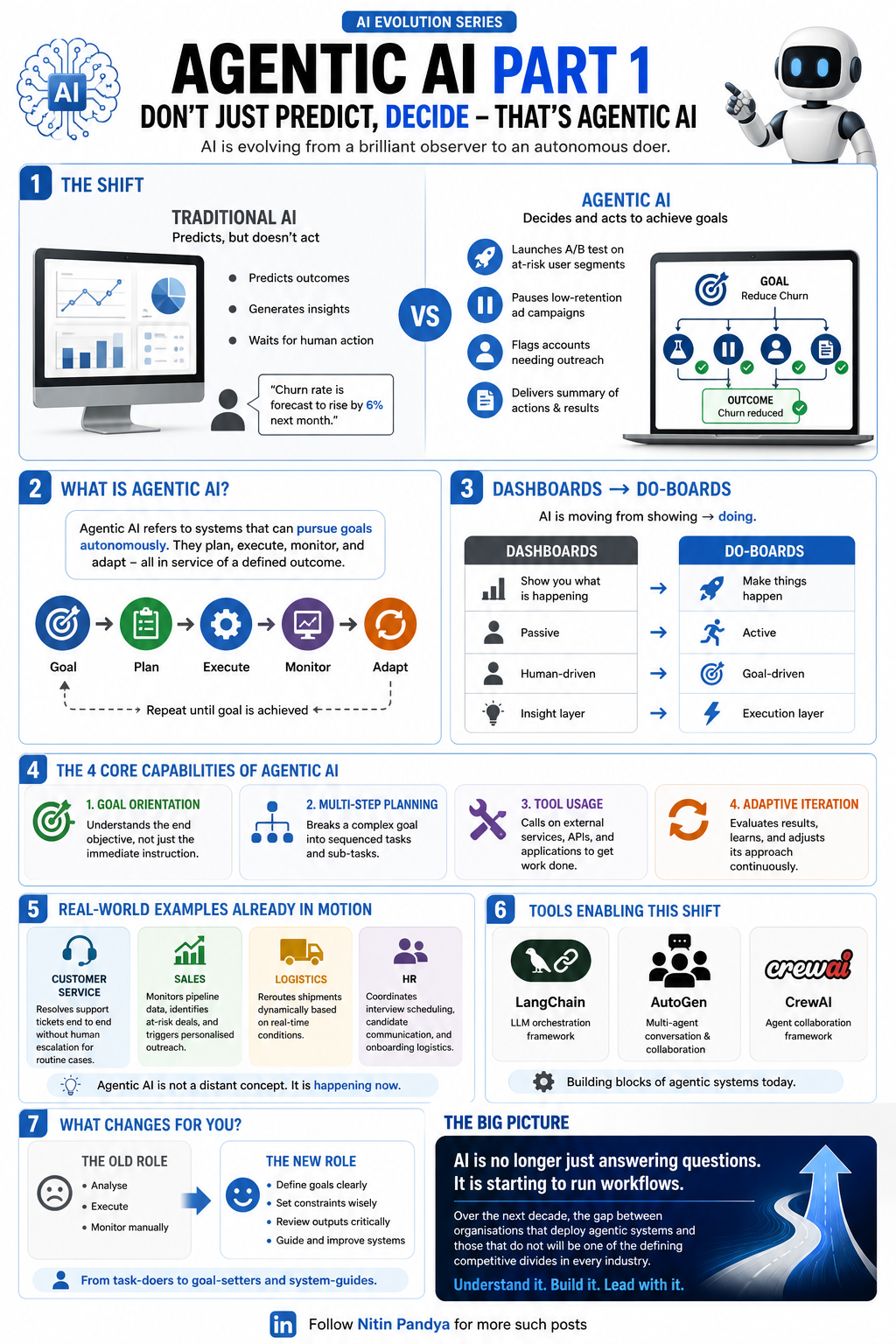
What Exactly Is Agentic AI?
Agentic AI refers to systems that can pursue goals autonomously. Rather than responding to a single input and stopping, an agentic system plans, executes, monitors, and adapts, all in service of a defined outcome.
Here is a simple contrast. A traditional AI model asked about customer churn might respond: the churn rate is forecast to rise by 6% next month. An agentic AI system given the same goal of reducing churn would act: it launches an A/B test on at-risk user segments, pauses low-retention ad campaigns, flags accounts needing human outreach, and delivers a summary of everything it did. That is not analysis. That is agency. Decision plus execution, running autonomously toward a goal.
From Dashboards to Do-Boards
The metaphor that captures this shift best is moving from dashboards to do-boards. Dashboards show you what is happening. Do-boards make things happen.
Agentic AI changes the traditional model by introducing four key capabilities: goal orientation, where the agent understands the end objective rather than just the immediate instruction; multi-step planning, where it breaks a complex goal into sequenced tasks; tool use, where it calls on external services and applications to complete work; and adaptive iteration, where it evaluates results and adjusts its approach based on what it learns.
This combination is what makes agentic systems feel less like tools and more like teammates.
Real-World Examples Already in Motion
Agentic AI is not a distant concept. Customer service agents are resolving support tickets end to end without human escalation for routine cases. Sales agents are monitoring pipeline data, identifying at-risk deals, and triggering personalised outreach. Logistics agents are rerouting shipments dynamically based on real-time conditions. HR systems are coordinating interview scheduling, candidate communication, and onboarding logistics with minimal human intervention.
Tools like LangChain, AutoGen, and CrewAI have made it possible for developers to build these systems today, using large language models as the reasoning core and connecting them to tools that take real-world actions.
Why This Matters for You
If an agent handles the execution, the human role shifts toward defining goals clearly, setting constraints wisely, and reviewing outputs critically. The professionals who thrive will be those who understand how to work with agents, not those who try to work around them.
Conclusion
Over the next decade, the gap between organisations that deploy agentic systems and those that do not will become one of the defining competitive divides in every industry. Understanding what agentic AI is, and what it is capable of, is the first step toward being on the right side of that divide.