
There's a question quietly circulating in product teams, startup war rooms, and corporate innovation labs alike: How does Anthropic keep shipping so fast?
In a world where most organisations are still debating roadmaps in quarterly reviews, Anthropic is iterating in real time, releasing features, gathering signals, and adapting before most teams have finished their next planning meeting. The secret isn't unlimited resources or superhuman engineers. It's a disciplined, systems-driven approach to how products are built, shipped, and evolved.
Here are the 8 principles behind their velocity and how you can apply them to your own organisation.
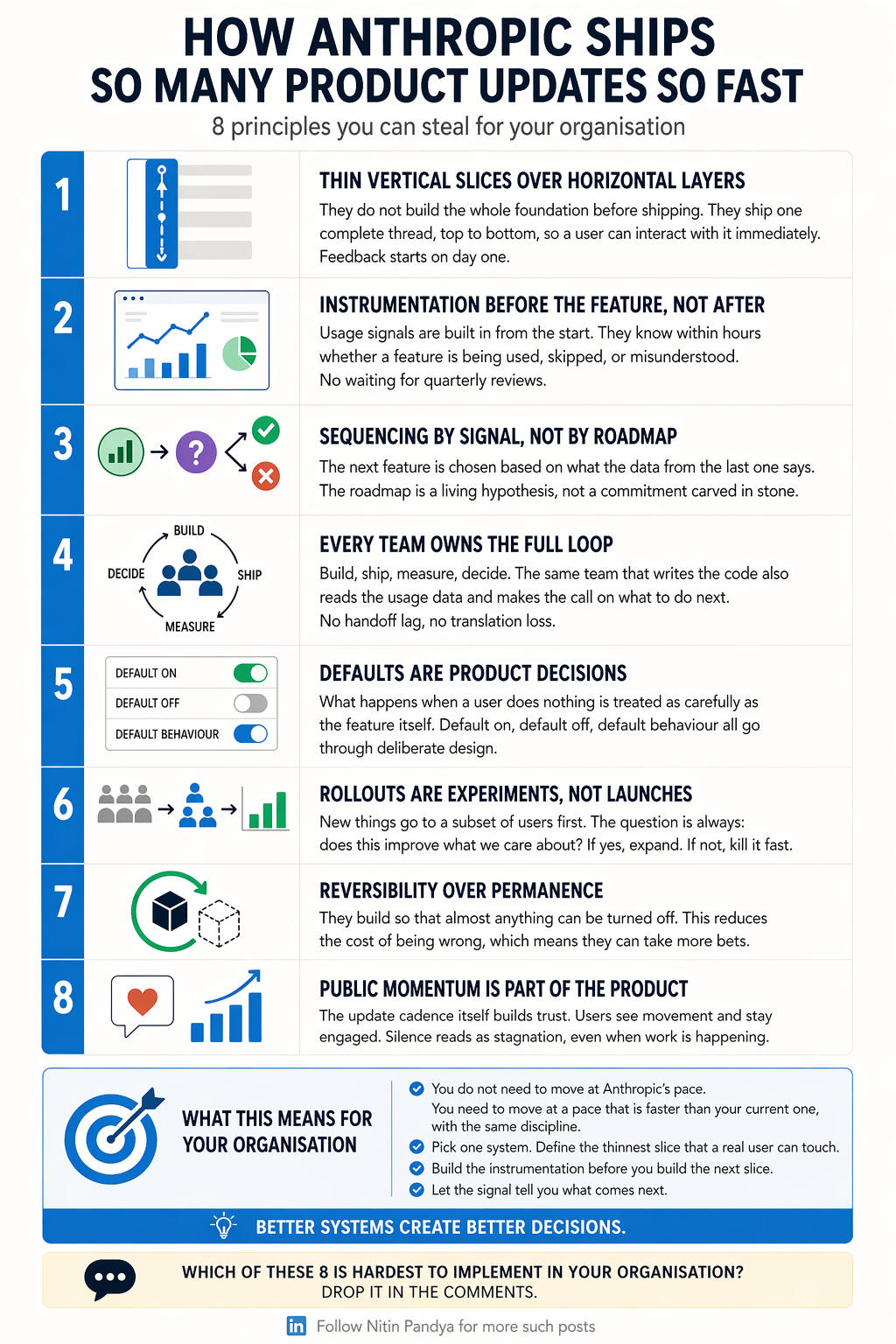
1. Thin Vertical Slices Over Horizontal Layers
Most teams build wide before they build deep. They lay down infrastructure, back-end logic, design systems, all before a single user can touch anything. Anthropic does the opposite.
They ship one complete thread, top to bottom, so a user can interact with it immediately. Feedback starts on day one. This approach eliminates the long, silent period between building and learning and it forces teams to stay focused on what a real user actually experiences, not what looks good on a Gantt chart.
Apply it: Pick the thinnest slice of your next project that a real user can touch. Ship that first.
2. Instrumentation Before the Feature, Not After
Measurement is usually an afterthought. Teams build, launch, and then figure out how to track whether it worked. Anthropic builds usage signals in from the start.
They know within hours whether a feature is being used, skipped, or misunderstood. No waiting for quarterly reviews. No guessing. This is the difference between flying with instruments and flying blind.
Apply it: Before you write a single line of feature code, define what signal will tell you if it's working. Then build that measurement first.
3. Sequencing by Signal, Not by Roadmap
A traditional roadmap is a commitment carved in stone. Anthropic treats theirs as a living hypothesis.
The next feature is chosen based on what the data from the last one says. If users are skipping a feature, that tells you something. If they're hacking around a limitation, that tells you even more. The roadmap follows reality, not the other way around.
Apply it: After every release, hold a signal review before your next planning session. Let the data have a seat at the table.
4. Every Team Owns the Full Loop
In many organisations, the team that builds a feature hands it off to another team to measure, and yet another to decide what happens next. Every handoff introduces lag and translation loss.
Anthropic gives each team the full loop: build, ship, measure, decide. The same people who write the code also read the usage data and make the call on what to do next. Accountability is complete. Speed is a natural result.
Apply it: Audit your current process. Where are the handoffs? Can one team own more of the loop than they currently do?
5. Defaults Are Product Decisions
What happens when a user does nothing? Most teams don't treat this as a design question. Anthropic does.
Default on, default off, default behaviour - all of these go through deliberate design. Because the reality is, most users never change their settings. The default is the product for the majority of people. Treating it carelessly is one of the most common and costly mistakes in product development.
Apply it: Review your product's defaults. Are they intentional? Do they serve the majority of your users in the best possible way?
6. Rollouts Are Experiments, Not Launches
A traditional launch is a moment, hyped up, high-stakes, irreversible. Anthropic treats every rollout as an experiment with a clear hypothesis.
New features go to a subset of users first. The question is always: does this improve what we care about? If yes, expand. If not, kill it fast. This removes the emotional weight from shipping decisions and replaces it with data-driven discipline.
Apply it: Stop treating launches as events. Start treating them as the beginning of a measurement cycle.
7. Reversibility Over Permanence
One of the most underrated principles in this list. Anthropic builds so that almost anything can be turned off. This reduces the cost of being wrong, which means they can afford to take more bets.
When reversibility is baked in, fear shrinks. Teams move faster because the downside of any single decision is contained. Innovation accelerates when the penalty for a wrong move isn't catastrophic.
Apply it: Before building any new feature, ask: how would we turn this off if we needed to? Build that exit before you build the feature.
8. Public Momentum Is Part of the Product
This one is often overlooked by technical teams. The cadence of updates itself builds user trust. When users see consistent movement, they stay engaged. When they see silence, they assume stagnation, even when real work is happening behind the scenes.
Anthropic's update rhythm isn't just about functionality. It's a communication strategy. It says: we are here, we are improving, we are listening.
Apply it: Make your progress visible. Regular, honest updates, even small ones, compound into deep user trust over time.
Better Systems Create Better Decisions
You don't need Anthropic's resources to apply these principles. You need discipline, clarity, and the willingness to let signals, not assumptions, drive your decisions.
Start small. Pick one system. Define the thinnest slice a real user can touch. Build the instrumentation before you build the next slice. And let the signal tell you what comes next.
That's not just how Anthropic ships fast. That's how any organisation can grow with intention, soul, and sustainable momentum.
At NrichSouls, we believe better systems don't just create better products. They create better teams, better leaders, and richer lives. Which of these 8 principles will you steal first?