
I did not set out to hit milestones. I set out to think better.
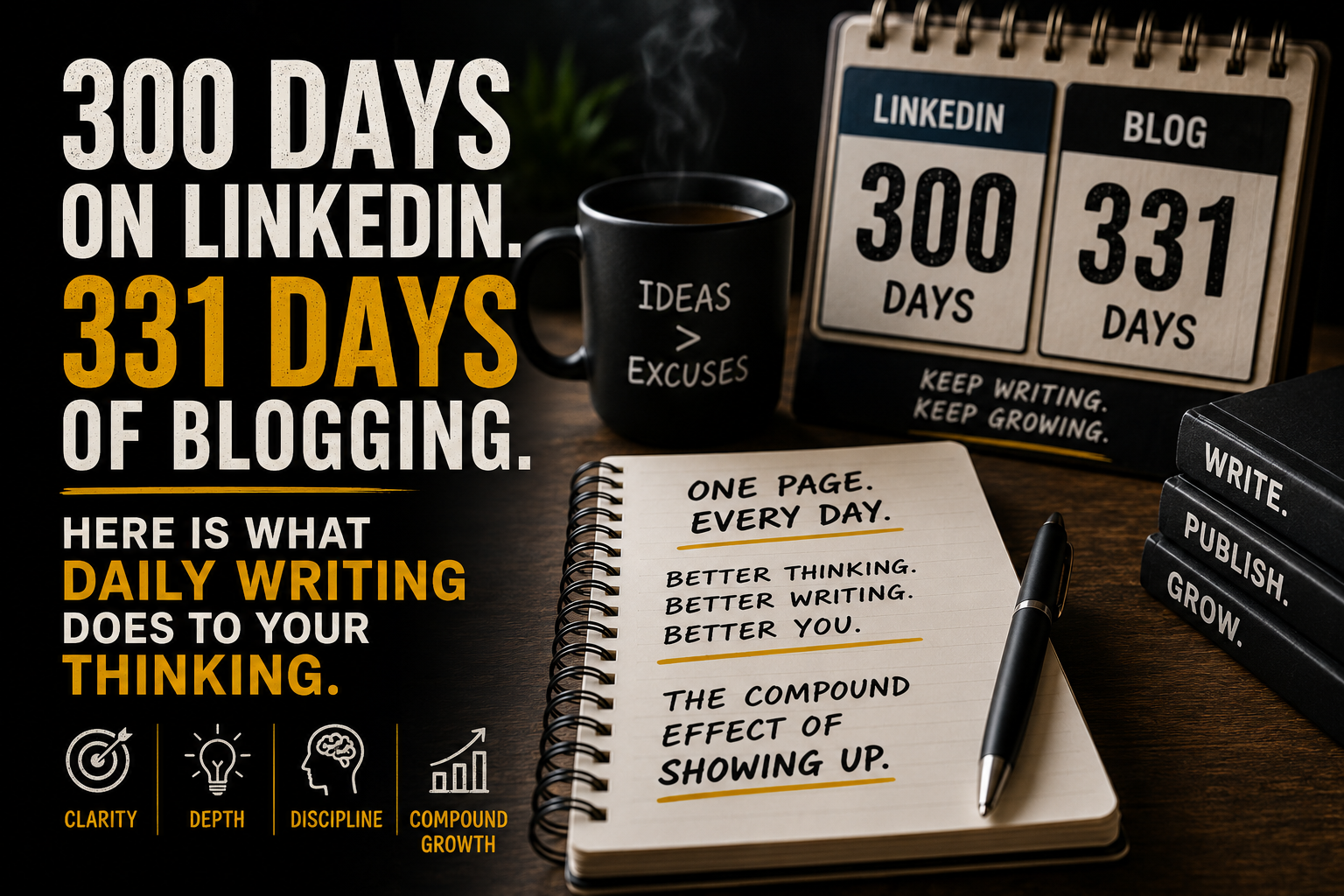
300 days of posting daily on LinkedIn. 331 days of writing on this blog. The numbers are not the point. But they are useful markers to stop and ask: what has actually changed? Not in the metrics. In the thinking.
The answer surprised me. And it is not what the content advice industry will tell you.
Two Formats, Two Different Kinds of Discipline
LinkedIn and a blog are not the same medium dressed differently. They demand different things from you, and they give different things back.
A LinkedIn post is a provocation. You have 250 words, one idea, and a reader who is scrolling past 40 other things. You have to earn attention in the first line and give something worth keeping in the last. The constraint is brutal, and it is useful. Writing 300 LinkedIn posts taught me to find the core of an idea fast. To strip away everything that is impressive-sounding but not actually necessary. To lead with what matters instead of building toward it.
A blog is a different contract. The reader has opted in. They gave you their time deliberately. That means you owe them depth, not just provocation. 331 days of blog writing taught me to stay with an idea past the point where it felt finished. To follow a thought into the uncomfortable territory where your certainty starts to crack and something more honest emerges.
Both disciplines are necessary. One sharpens. One deepens. Together, they do something neither can do alone.
What Daily Writing Actually Trains
Here is the thing about writing every day that no one tells you at the beginning: you are not training output. You are training perception.
When you know you have to write tomorrow, you move through today differently. A meeting that would have washed over you becomes something you are listening to more carefully. A data point that would have been interesting but forgettable now connects to something you wrote last week. A frustration at work is no longer just a frustration. It is the beginning of a paragraph.
Daily writing installs a different relationship with your own experience. You start noticing at a different resolution. Not because you are more intelligent, but because you have a use for the detail. The writer's eye is not a talent. It is a habit.
After 300 days on LinkedIn and 331 days on this blog, I notice things in conversations, in client meetings, in data that I would previously have let pass. Not because I am smarter. Because I have trained myself to ask: what is actually going on here, and can I explain it clearly?
The Compounding That Surprised Me Most
I expected to get better at writing. I did not expect to get better at thinking under pressure.
Here is what happened: 300 LinkedIn posts mean 300 times I had to take a complex or half-formed idea and make it legible to a senior professional scrolling on a Tuesday morning. That is a very specific kind of pressure. You cannot hide behind jargon. You cannot gesture at complexity without landing somewhere clear. You have to mean what you say.
331 blog posts mean 331 times I had to follow an idea far enough that it either held up or fell apart. Many fell apart. That is not failure. That is the point. Writing long enough to discover that you were wrong about something is one of the highest-value activities a thinking person can do.
The combination of these two pressures, brevity and depth, short form and long, created something I did not plan for. A clearer internal voice. One that knows the difference between what sounds like an insight and what actually is one.
The Honest Part
Some days the writing is not good. Some days the LinkedIn post is mechanical and the blog feels like I am going through motions. Streaks survive those days, not because of discipline, but because the bar on those days is simply: write something true and publish it. It does not have to be brilliant. It has to be honest.
That lower bar is not a compromise. It is the design. The days when you write something mediocre and publish it anyway are the days that make the streak structurally sound. They prove to you that the habit does not depend on inspiration. That is the only way a habit survives long enough to compound.
What I Know Now That I Did Not Know Then
At day one, I thought daily writing was a content strategy. At day 300 on LinkedIn and day 331 here, I know it is a cognitive practice.
It has made me a clearer thinker, a more confident speaker, and a more honest professional. Not because those things are side effects of publishing. Because they are the direct result of repeatedly asking: what do I actually believe, and can I say it plainly?
If you are waiting for a better time to start, there is no better time. The voice you are looking for is not waiting somewhere ahead of you. It is waiting on the other side of the first post you are afraid to publish.
Day 301 on LinkedIn. Day 332 here. See you there.
Follow NrichSouls for reflections on AI, data, leadership, and the slow work of building something worth building.